

Futures traders are always looking for an edge. Some rely on experience, others on data, and many use trading signals to help spot trade opportunities. But what exactly are futures trading signals? How do they work, and what should you watch out for?
In this guide, we’ll break it all down. You’ll learn what futures trading signals are, where they come from, how traders use them, and why they’re only one piece of a much bigger puzzle.
Key Takeaways
- A futures trading signal is a rule or trigger that suggests when to enter or exit a trade based on price, indicators, volume, or news.
- Futures trading signals are tools, not guarantees, because they only point to possible trade setups, not sure wins.
- Signals come from many sources, including indicators, chart patterns, volume, and news.
- Signals work best inside a full trading plan that includes timing, confirmation, and clear rules.
- Risk control matters more than any signal since even strong setups can still lose.
What Are Futures Trading Signals?
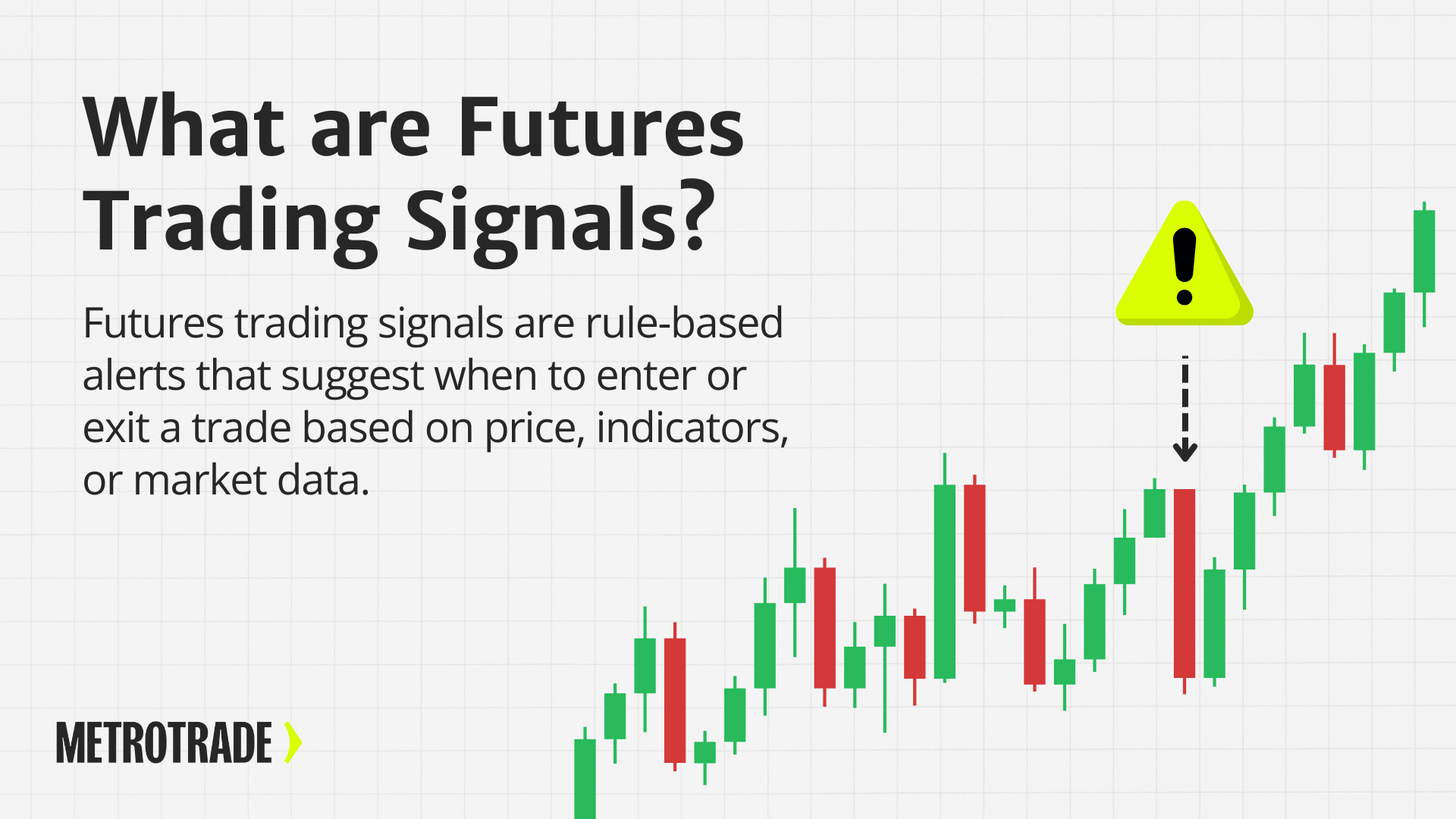
Futures trading signals are specific triggers that suggest a potential time to enter or exit a futures trade. These signals are based on real market data, not hunches or gut feelings.
They’re used by traders to spot setups that align with their strategies. Some traders identify signals manually. Others use software or platforms that generate alerts automatically. Either way, the goal is the same: find trades with better odds.
Key characteristics of a futures trading signal:
- Based on technical indicators, price action, volume, or news
- Helps spot possible trade setups in real time
- Can be visual (on a chart) or delivered as an alert
- Used for both entries and exits
- Works best when paired with a full trading plan
Signals don’t predict the future. Instead, they highlight potential setups based on current market behavior. For example, if crude oil futures break above resistance while volume spikes, that may act as a bullish signal for some traders.
Common sources of trading signals include:
- Technical analysis: Moving averages, RSI, MACD, Bollinger Bands, and more
- Chart patterns: Breakouts, reversals, candlestick formations
- Volume and order flow: Spikes, imbalances, or divergence from price
- News and fundamentals: Economic reports, inventory data, or geopolitical headlines
Traders often combine signals for stronger confirmation. One signal might show momentum, while another confirms trend direction. Used together, they can offer a more complete picture.
But signals are not guarantees. A strong setup can still fail. That’s why experienced traders treat them as tools, not answers. They also use stop losses, position sizing, and risk rules to protect themselves when signals don’t work out.
Types of Futures Trading Signals
There are many types of signals in the world of futures. Some are simple. Others are complex. What matters most is using the ones that fit your strategy, timeframe, and comfort level.
Technical Indicator Signals
Technical indicators are popular tools for generating signals. They take price or volume data and turn it into something more visual or calculated.
Common examples include:
- Relative Strength Index (RSI): Often used to spot overbought or oversold conditions. A reading above 70 might signal a possible pullback. Below 30 might suggest a bounce.
- MACD (Moving Average Convergence Divergence): Crossovers between the MACD line and signal line can suggest changes in trend momentum.
- Bollinger Bands: Price touching or breaking the bands may signal volatility or potential reversals.
Learn more about Technical Analysis in Futures
Price Action and Chart Patterns
Chart patterns and candlestick formations can also act as trading signals. These are visual cues based on how price behaves over time.
Examples include:
- Breakouts: When price breaks above resistance or below support, traders often see it as a signal to enter in the direction of the break.
- Support and Resistance Bounces: If price bounces off a known level, it may signal a continuation or reversal.
- Candlestick Patterns: Hammers, doji candles, and engulfing patterns can signal a shift in momentum.
Fundamental or News-Based Signals
Some traders use macroeconomic data or news events as signals. This is more common in futures markets tied to interest rates, commodities, or currencies.
Examples include:
- Economic Releases: Reports like CPI, Nonfarm Payrolls, or FOMC decisions often trigger strong market reactions.
- Inventory Data: For energy and agricultural futures, data on supply and demand can move prices sharply.
- Geopolitical News: War, sanctions, or trade policies can act as signals, especially in commodities.
Learn more about Fundamental Analysis in Futures
Algorithmic and Signal Service Alerts
Some traders use third-party services or platforms that generate signals automatically. These systems analyze technical or fundamental data and send alerts when conditions match certain rules.
While convenient, not all services are reliable. Many overpromise and underdeliver. It’s important to understand how a signal is generated before acting on it.
Volume and Order Flow Signals
Volume and order flow give insight into how much participation is behind a move. These signals are useful for day traders and scalpers who want to trade with the flow of the market.
Examples include:
- Volume Spikes: Sudden increases in volume can signal strong interest or breakout potential.
- Delta Divergence: A mismatch between price and net buying/selling pressure.
- Order Book Imbalances: If buyers or sellers dominate the book, it may suggest an incoming move.
How Traders Use Signals in Futures Trading
Trading signals are only useful if you know how to apply them. A signal might highlight a potential setup, but it’s the trader’s job to decide what to do with it — or whether to act at all.
Smart futures traders don’t blindly follow signals. They use them as part of a structured process that includes confirmation, timing, and risk management.
1. Using Signals to Time Entries and Exits
One of the most common uses of futures trading signals is to decide when to get in or out of a trade. A signal can mark the start of a trend, the end of one, or simply a short-term move worth taking advantage of.
Examples:
- An RSI reading below 30 on the Nasdaq-100 micro futures might suggest a possible short-term bounce.
- A breakout above resistance with strong volume in gold futures may be used as a long entry signal.
- A MACD bearish crossover on the E-mini S&P 500 could prompt a trader to take profits or exit.
Signals don’t make decisions, they give you options. What matters is how you use discretion react to them.
2. Filtering Out Bad Market Conditions
Not every session is worth trading. Futures signals can help traders stay out of low-quality setups or choppy markets where the odds are unclear.
Traders often use signals to avoid:
- Low-volume periods, like midday or pre-market
- Sideways markets with no clear trend
- Breakouts without confirmation from volume or momentum
This kind of filtering helps reduce overtrading and protects your capital during uncertain conditions.
3. Building Structure Into a Full Trading Plan
The best futures traders don’t rely on one signal or setup. They combine signals with other tools and rules to create a complete trading plan.
That usually includes:
- Clear entry rules (based on one or more signals)
- Stop loss levels based on volatility or price structure
- Position sizing to control risk per trade
- Exit strategies based on targets, trailing stops, or reversal signals
Without a plan, a signal is just a suggestion. With a plan, it becomes a rule you can test, refine, and stick to.
Common Signal-Based Strategies in Futures Trading
Trend Following
Trend followers often use moving averages or ADX indicators. For example, a crossover of the 50-day and 200-day moving averages might signal a long-term trend change. Indicators like the ADX can help confirm the strength of that trend.
Momentum Breakouts
Momentum traders look for strong moves backed by volume. They might use RSI, MACD, and price levels together to spot breakouts. A breakout above resistance with high volume is often used as a signal to go long.
Mean Reversion
This strategy assumes prices will return to a normal level after a strong move. RSI or Bollinger Bands are common tools here. If price stretches too far from its average, it may snap back — creating a short-term trade setup.
News or Volatility Triggers
Some traders trade around scheduled events. For example, crude oil futures often move after EIA inventory data. Traders use the data release as a trigger, sometimes combined with technical confirmation.
You can explore these strategies further in our related guides:
Open Your Account Today
Start trading futures with ultra-low commissions and margins as low as $50.
Benefits of Using Trading Signals
Futures trading signals aren’t just for beginners. Even experienced traders use them to stay consistent and reduce decision fatigue. The real benefit isn’t in finding the “perfect” setup, but in having a structured approach to entering and exiting trades.
Here’s how trading signals can help:
1. Faster Decision-Making
Signals cut down the time it takes to analyze a market. Instead of second-guessing, you react to pre-defined criteria.
- No more staring at charts waiting for a “feeling”
- More confidence during volatile or fast-moving sessions
- Easier to identify setups that match your strategy
2. Increased Consistency
Following trading signals helps remove emotional bias. When you follow clear, rule-based signals, you’re less likely to make impulsive decisions.
- Helps avoid revenge trading or overtrading
- Supports a disciplined trading routine
- Easier to backtest and improve over time
3. Scalability Across Markets
Once you understand how signals work, you can apply them to different asset classes and timeframes — including micro futures, e-minis, metals, energy, and more.
- Use similar setups across indices, commodities, and currencies
- Adjust risk and contract size depending on your account
- Trade part-time or full-time using repeatable methods
4. Easier to Test and Refine
Because signals are rule-based, they’re easier to test on historical data or in a futures demo account. This makes it easier to improve over time.
- Backtest setups to see what works and what doesn’t
- Fine-tune entry/exit rules without risking real money
- Build confidence before going live
Risks and Limitations of Trading Signals
As helpful as they can be, trading signals are not foolproof. They are just tools, and if you treat them like shortcuts, they can do more harm than good.
Here’s what to watch out for:
1. False Signals
Not every signal leads to a good trade. Sometimes the market gives a clean setup, then immediately reverses.
- Breakouts that fail and turn into fakeouts
- Indicators that lag or trigger too early
- Signals that don’t reflect changing market conditions
2. Over-Reliance on One Tool
Many new traders pick one indicator and treat it like a crystal ball. That usually ends badly.
- No signal works in every market condition
- Blindly following alerts can lead to losses
- Signals need confirmation and context
3. Lagging Indicators
Some signals are based on past price data, which means they react after a move has already started.
- Moving averages and MACD can be slow to respond
- You might enter late and miss the best part of the move
- Chasing trades leads to bad entries and poor risk-reward
4. Signal Overload
Trying to use too many signals at once can create “analysis paralysis.” This makes it harder to act and increases hesitation.
- Conflicting signals create doubt
- Complexity leads to inconsistency
- Simpler strategies often perform better
5. No Built-In Risk Control
A signal tells you when to trade — not how much to risk or where to exit. Without stop losses and sizing rules, even a solid signal can lead to a large loss.
Why Risk Management Still Comes First
A strong signal can still lead to a losing trade. That’s why every trader needs a solid risk plan. At a minimum, this should include:
- A stop loss and take profit on every trade
- Position sizing that reflects your risk tolerance
- No revenge trading if a signal fails
Think of signals like road signs. They guide you, but they don’t steer the car.
How to Create or Customize Your Own Signals
Once you understand how signals work, you can build your own. Here’s how:
- Combine indicators that fit your trading style
- Add filters like volume or time of day
- Backtest your setup to see how it performs
Tools like MetroTrader make this easier. You can:
- Add indicators with a few clicks
- Set alerts for when your conditions are met
- Practice your signals in a risk-free demo account
Trading Signals on the MetroTrader Platform
If you want to explore futures trading signals in a real platform environment, MetroTrader makes it easy to get started. You don’t need special software or expensive tools — the signals you need are already built in.
MetroTrader includes many of the most popular technical indicators used by futures traders. These tools can help you spot potential trade setups, monitor trends, and get a better read on market conditions — all with a clean, intuitive interface.
Indicators You Can Use on MetroTrader:
- RSI (Relative Strength Index): Identify overbought or oversold conditions with a glance.
- MACD: Spot momentum shifts and trend changes using MACD crossovers.
- Bollinger Bands: Monitor volatility and price extremes to time reversals or breakouts.
- Moving Averages (SMA/EMA): Track trend direction and create crossover signals.
- Fibonacci Levels: Mark key retracement areas for possible entry or exit zones.
- Volume and VWAP: See how trading activity supports price action throughout the session.
All indicators are customizable, so you can adjust the settings to match your style or strategy.
Want to Know When a Signal Is Triggered? Set an Alert.
With MetroTrader’s built-in alert system, you can create custom alerts for key levels, indicator crossovers, or price conditions. Instead of watching charts all day, let the platform notify you when a signal is ready.
Alerts are mainly price-based, for example: “Notify me when MES hits 4900”.
This is a powerful way to stay active in the market without having to be glued to your screen.
Conclusion
Futures trading signals are valuable tools. They help you spot opportunities, stay consistent, and reduce emotional bias. But they’re not foolproof. No signal is perfect, and no setup works every time.
Use signals as part of a complete strategy, not a shortcut. Understand how they work, pair them with risk management, and always test them before trading with real money.
Want to see how signals fit into your own trading style?
Try them in live futures markets once you open and fund your futures trading account. Explore indicators, test strategies, and learn at your own pace.
FAQs
What is a futures trading signal?
A futures trading signal is a rule-based trigger that suggests when to buy or sell a futures contract, based on indicators, price patterns, volume, or news events.
How accurate are futures trading signals?
Futures trading signals are not always accurate and should be used with confirmation tools and risk management to reduce the chance of false entries.
What is the difference between a trading signal and a trading strategy?
A trading signal is a specific cue to act, while a trading strategy is a complete plan that includes signals, risk management, position sizing, and exit rules.
Can beginners use futures trading signals?
Yes, beginners can use futures trading signals to learn how to spot setups, but it’s important to practice in a demo account before trading live.
Can I set up automated trading signals on MetroTrader?
MetroTrader supports custom alerts and technical indicators, but fully automated trading may require integration with third-party tools.
What is the best trading signal for futures?
There is no single best trading signal for futures. Effectiveness depends on your market, strategy, and risk tolerance.
The content provided is for informational and educational purposes only and should not be considered trading, investment, tax, or legal advice. Futures trading involves substantial risk and is not suitable for every investor. Past performance is not indicative of future results. You should carefully consider whether trading is appropriate for your financial situation. Always consult with a licensed financial professional before making any trading decisions. MetroTrade is not liable for any losses or damages arising from the use of this content.