

Trend following is one of the most popular trading strategies out there. It’s used by everyone from solo retail traders to billion-dollar hedge funds. Why? Because when markets move, they often move far. Trend following provides a way to try to catch those moves.
Unlike strategies that aim to predict reversals, trend following focuses on what the market is already doing. If prices are rising, a trend follower seeks opportunities to capitalize on that momentum. If prices are falling, they look for chances to ride the move down.
This guide breaks down how trend following strategies work, why they’re used, and how beginners can apply them to markets like futures, stocks, forex, and crypto. Whether you’re just starting or looking to improve your trading, understanding this strategy can help you build a smarter approach.
Key Takeaways
- A trend following strategy looks to profit from strong directional moves in the market, either up or down.
- This strategy reacts to price action, rather than trying to predict turning points.
- Tools like moving averages, breakouts, and momentum indicators help identify trends and manage trades.
- Trend following can work across different assets and timeframes, but tends to perform best in trending markets.
- Good risk management is critical, since trend following often involves lower win rates but higher average gains per trade.
What Is a Trend Following Strategy?
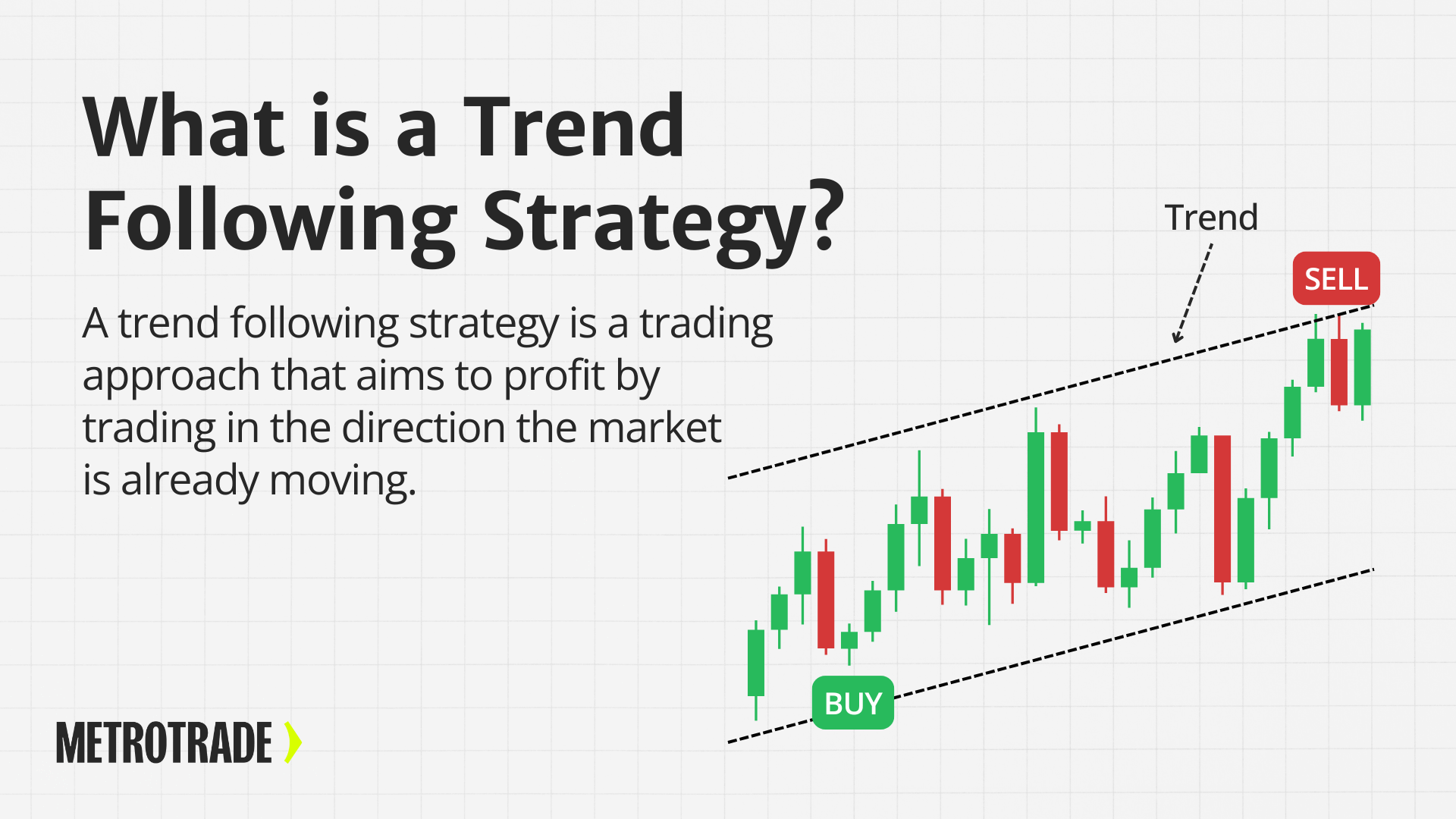
A trend following strategy is a trading method that tries to capture gains by riding the direction of a market trend. It’s not about calling tops or bottoms. It’s about getting in once the trend is clear and staying in as long as the market continues in that direction.
This style of trading works in both directions. If a market is climbing, you go long. If it’s dropping, you go short. The goal is to stay with the trend until there’s enough evidence that it’s over.
Trend followers don’t try to outsmart the market. They follow it. That’s what makes this strategy attractive to new traders. It’s simple to understand and easy to test, even though it still requires patience and discipline.
How Trend Following Works
The Basic Idea
The core concept is this: trends tend to persist. If the market is already moving in one direction, it may keep going that way for a while. Trend following strategies enter trades once the trend has been confirmed and exit when there are signs of a reversal or slowdown.
Common Entry Signals
There are several common methods traders use to confirm a trend before entering:
- Breakouts: Entering a trade when the price breaks above resistance or below support.
- Moving average crossovers: When a short-term moving average crosses above a longer-term one (bullish), or below it (bearish).
- Momentum indicators: Tools like the MACD or RSI can confirm strength behind a move.
The key is waiting for confirmation. Trend followers typically don’t try to catch the very start of a move. They prefer to wait until the market has shown a clear direction.
Exit Strategies
Exiting a trade is just as important as entering. Some common exit methods include:
- Trailing stop-losses: These adjust upward or downward as the trade moves in your favor, helping lock in profits.
- Moving average crossbacks: For example, if a 50-day moving average crosses back below the 200-day, it could signal that the trend is ending.
- Volatility-based exits: Indicators like Average True Range (ATR) can help set wider stops in more volatile markets.
The goal of the exit is to stay in the trade long enough to benefit from the trend but get out before giving too much back.
Why Traders Use Trend Following Strategies
Capturing Big Moves
One of the main appeals of trend following is the chance to catch large moves. Not every trade will be a winner, but the strategy is built to make more on the big winners than it loses on the small losers.
Simple Rules, Strong Discipline
Trend following strategies can be built with clear entry and exit rules. This removes a lot of emotional decision-making from trading. It’s easier to stick to a plan when you’re not guessing what the market will do next.
This simplicity also makes the strategy a good candidate for automation or systematic trading.
Works Across Markets
Another benefit is versatility. Trend following can be used in:
- Stock markets
- Futures markets
- Crypto markets
- Forex pairs
- Commodities
As long as the market trends, the strategy has a chance to work.
Common Indicators Used in Trend Following
While no single tool guarantees success, there are a few indicators that trend followers often rely on.
Moving Averages
Moving averages help smooth out price data and highlight direction. Two of the most popular types are:
- Simple Moving Average (SMA): An average of past prices over a set period.
- Exponential Moving Average (EMA): Gives more weight to recent prices, making it more responsive.
Common settings include 50-day, 100-day, and 200-day averages. A shorter average crossing above a longer one can signal the start of a new uptrend.
Average True Range (ATR)
ATR measures volatility. Trend followers use it to:
- Set stop-loss distances
- Decide how large a position to take
- Avoid entering during low-volatility periods
MACD (Moving Average Convergence Divergence)
MACD tracks the difference between two EMAs and helps confirm trend strength and momentum. When MACD crosses above its signal line, it can be a bullish sign. When it crosses below, it can signal weakness.
ADX (Average Directional Index)
ADX measures the strength of a trend, regardless of direction. A reading above 25 often means a strong trend, while a reading below 20 may suggest a choppy or sideways market.
All of these indicators are available in MetroTrader, our web-based futures trading platform.
Trend Following in Futures Trading
Why Futures Work Well for Trend Following
Futures markets are often ideal for trend followers due to:
- High liquidity: Makes entries and exits easier
- Leverage: Allows small account sizes to take larger positions (with increased risk)
- Market variety: From commodities to indexes to interest rates, futures cover many asset classes
- Macro drivers: Futures are heavily influenced by supply and demand, global news, and economic data, all of which can create long-lasting trends
Examples of Trending Futures Markets
Some contracts are more prone to trends than others. Popular ones include:
- Crude Oil (CL): Sensitive to geopolitical and supply factors
- Gold (GC): Often trends based on inflation or interest rate expectations
- E-mini S&P 500 (ES): Follows broader market sentiment
- Euro FX (6E): Moves based on monetary policy and global currency flows
New traders can also start with micro futures, which have lower margin requirements and allow for smaller positions.
Trade Futures for Less
Start trading futures with ultra-low commissions and margins as low as $50.
Pros and Cons of Trend Following Strategies
Pros
- Scalable: Works in different markets and timeframes
- Simple rules: Easier to backtest and follow
- Asymmetric returns: One big win can cover many small losses
Cons
- Choppy markets hurt performance: Trend following often struggles in sideways or range-bound conditions
- Lower win rate: Many small losses are common
- Requires patience: Holding through drawdowns or waiting for the next trend can test nerves
Tips for Getting Started with Trend Following
Focus on One Market to Start
Trying to follow too many markets can dilute focus. Start with one that trends well, like crude oil or the Nasdaq-100 futures.
Journal Your Trades
Keeping a trade journal lets you track what works and what doesn’t. Include your reason for entry, exit, and how the trade played out.
Manage Your Risk
Always know how much you’re risking on each trade. Use stop-loss orders and position sizing based on your account size and the asset’s volatility.
Real-World Example: Simple Trend Following Setup
Let’s say a trader uses the 50-day and 200-day moving average crossover.
- Entry: Go long when the 50-day SMA crosses above the 200-day SMA
- Stop Loss: Set below a recent swing low, or use 2x the ATR
- Exit: Exit when the 50-day crosses back below the 200-day, or when the price closes below the trailing stop
This basic setup gives new traders a clear plan to follow. It also allows easy backtesting with historical data.
Trend Following vs Mean Reversion
- Goal: Trend following aims to ride the momentum of a market that’s already moving. Mean reversion looks to profit when prices return to an average or prior level after a temporary move.
- Entry style: Trend followers enter after a trend is confirmed. Mean reversion traders often enter near support or resistance, expecting the price to bounce back.
- Market conditions: Trend following works best in markets with clear direction. Mean reversion strategies are better suited to sideways or range-bound conditions.
- Risk: Trend followers may get whipsawed in choppy markets. Mean reversion traders risk getting caught when a price breaks out and doesn’t come back.
Some traders use both approaches, switching based on market conditions or combining them in different strategies.
Common Mistakes New Trend Followers Make
- Getting in too early
Trying to predict a trend before it’s confirmed often leads to losses. - No clear exit plan
Holding on too long or exiting too early can both hurt performance. - Ignoring risk management
One bad trade without a stop-loss can wipe out weeks of gains. - Giving up too soon
Trend following requires discipline. If you quit after a few losses, you’ll miss the big winners.
Final Thoughts on Trend Following Strategies
A trend following strategy is one of the most time-tested ways to approach the markets. It doesn’t promise quick wins, but it offers a clear and structured way to trade. For beginners, it’s a great foundation to build trading experience.
Remember, the strategy is about following, not forecasting. The real edge comes from sticking to your rules and managing your risk. Over time, that consistency can help you improve and grow as a trader.
Want to try trend following? Open a MetroTrade account and see how this strategy works across real futures markets. Practice your setups, test your indicators, and start building your trading confidence.
Frequently Asked Questions
What is a trend following strategy in trading?
A trend following strategy is a trading method that aims to profit by entering trades in the direction of an existing trend. Traders use tools like moving averages or breakouts to confirm the trend and stay in as long as it continues.
Is trend following profitable?
Trend following can be profitable, especially in markets with strong directional movement. It usually involves more losing trades than winning ones, but the winners are often much larger, leading to positive overall results when risk is managed well.
What is the best indicator for trend following?
Popular indicators include moving averages, MACD, and ADX. There’s no single “best” indicator, but moving average crossovers are commonly used by beginners.
Does trend following work in all markets?
It can work in many markets, including futures, stocks, forex, and crypto. However, it performs best in markets that tend to trend over time.
What timeframe is best for trend following?
Trend following works across timeframes, from 5-minute charts to daily or weekly. Longer timeframes typically offer stronger signals and less noise, which may be better for beginners.
What is a good risk-reward ratio for trend following?
A risk-reward ratio of 1:2 or better is often used. The strategy relies on big winners to offset smaller losses, so aiming for trades that can return more than they risk is key.
The content provided is for informational and educational purposes only and should not be considered trading, investment, tax, or legal advice. Futures trading involves substantial risk and is not suitable for every investor. Past performance is not indicative of future results. You should carefully consider whether trading is appropriate for your financial situation. Always consult with a licensed financial professional before making any trading decisions. MetroTrade is not liable for any losses or damages arising from the use of this content.