

If you’ve ever wondered whether your trading strategy will work before putting real money on the line, you’re not alone. That’s where futures backtesting comes in. Backtesting is the process of testing a trading strategy using historical futures data to see how it would have performed in the past.
Futures markets move fast. They’re leveraged, volatile, and often unpredictable. Without some way to test your edge, you’re flying blind. Backtesting can help you understand your strategy’s strengths and weaknesses before you go live. And while MetroTrader doesn’t include an automated backtesting feature, traders can use its free demo account to practice and refine their strategies in a live environment with no real risk.
This guide breaks down what futures backtesting is, how it works, and how you can use it to improve your consistency and confidence as a trader.
Key Takeaways
- Futures backtesting helps traders validate strategies before risking real money. It uses historical price data to simulate how a trading plan would have performed in the past.
- A good backtest includes realistic trade rules and risk assumptions. This means factoring in things like stop losses, profit targets, commissions, and slippage.
- Backtesting isn’t perfect, but it reveals the strengths and weaknesses of your strategy. It gives you a clear picture of potential outcomes and areas that need improvement.
- You can use MetroTrader’s demo account to test strategies in real-time conditions. While it doesn’t have automated backtesting, the demo lets you simulate trades without risking capital.
What Is Futures Backtesting?
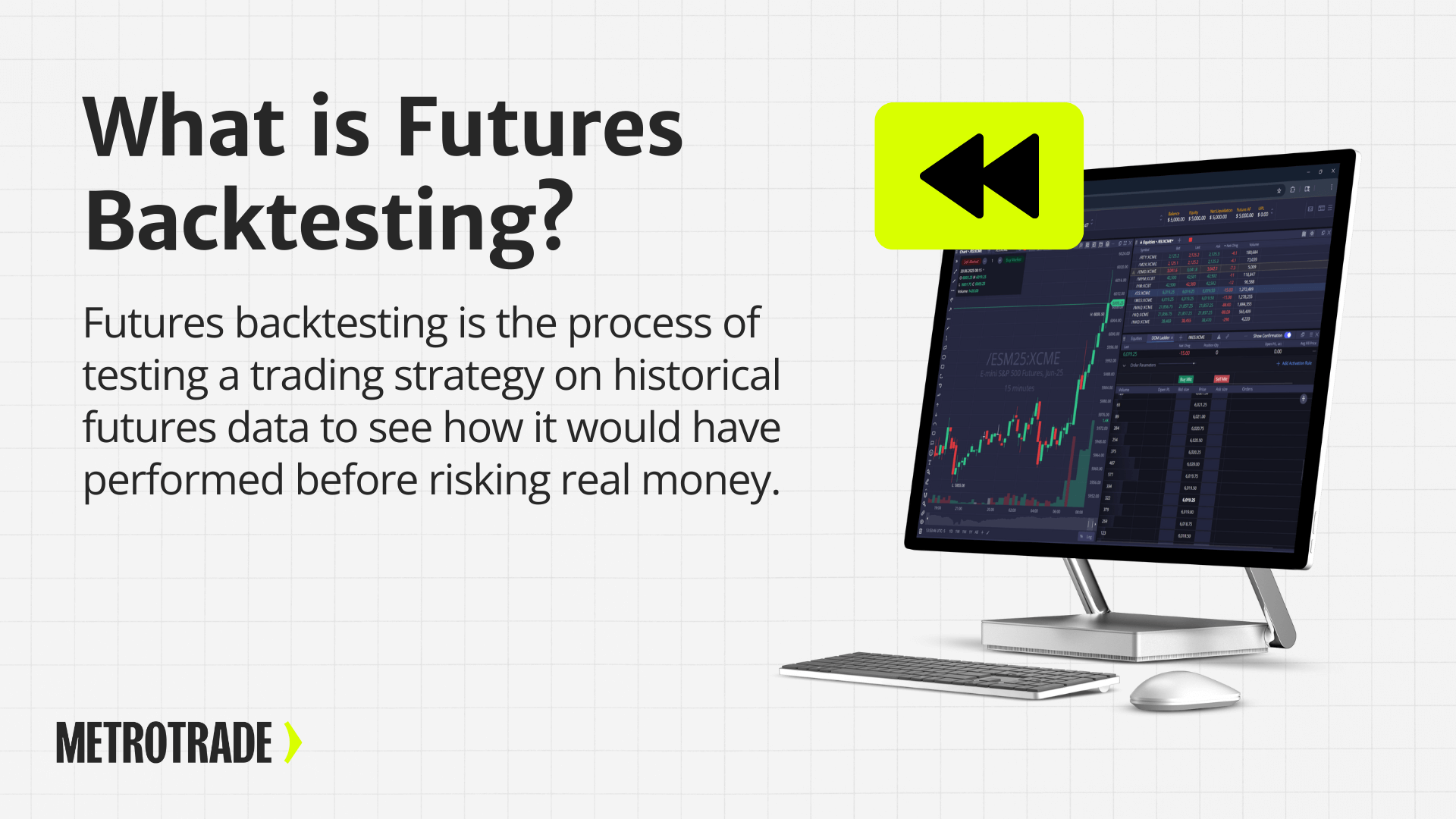
Futures backtesting is the process of simulating a trading strategy on past market data. Instead of trading live, you look at historical price movements and apply your rules to see how a strategy would have performed.
It’s like running a “what-if” experiment. You define your entries and exits, apply those rules to a specific futures contract, and track the outcomes. The goal is not to predict the future perfectly. Instead, it’s to build confidence and spot potential flaws before risking capital.
For example, a trader might backtest a trend-following strategy using Micro E-mini S&P 500 futures (MES) on a 15-minute chart. By checking how that strategy would have played out over the last three months, the trader can see whether it had a positive or negative result.
Why Futures Traders Use Backtesting
Futures trading involves leverage, margin, and fast price action. One bad strategy can wipe out an account if you’re not careful. That’s why experienced traders rely on backtesting to filter out weak or inconsistent setups.
Here’s why backtesting matters:
- Reduces emotional decision-making: You trade based on a plan, not panic
- Exposes strategy flaws: You can spot mistakes or unrealistic expectations before it’s too late
- Improves risk management: Testing different stop losses and position sizes helps find what works
- Builds discipline: You learn to follow a set of rules, which helps in live trading.
- Boosts confidence: If your strategy has a solid track record in testing, you’re more likely to stick with it
How Futures Backtesting Works (Step-by-Step)
1. Pick a Market and Timeframe
Choose a specific futures contract and chart interval. For example, Micro Crude Oil (MCL) on a 5-minute chart. Make sure there’s enough historical data to test a wide range of market conditions.
2. Define Your Strategy
Write clear, objective rules. For example:
- Buy when RSI crosses below 30 and then turns up
- Sell when the price touches the upper Bollinger Band
Your strategy can include trend, momentum, or breakout indicators.
3. Add Stop Loss and Take Profit Levels
Every trade should include a plan for exits. Decide whether you’ll use a fixed stop loss, a trailing stop, or indicator-based exits.
4. Apply the Strategy to Historical Data
Go candle by candle and simulate trades based on your rules. Log each trade in a spreadsheet or journal. This is manual backtesting and works well for beginners and discretionary traders.
5. Track and Analyze the Results
Once you have taken some trades, look at your performance metrics. Did the strategy produce a consistent outcome? How big were the losses during losing streaks?
Manual vs Automated Backtesting
Manual Backtesting
This approach involves scrolling through a chart and simulating trades one at a time. You visually identify entries and exits and track them in a notebook or spreadsheet.
Pros:
- Builds chart-reading skills
- Great for discretionary strategies
- Helps you understand the setup in a real-time context
Cons:
- Time-consuming
- Can be biased if you skip losing trades or cherry-pick winners
Automated Backtesting
This uses software to apply rules and scan historical data. It’s common for algorithmic traders and those who use rule-based strategies.
Pros:
- Fast and efficient
- Large datasets can be tested quickly
- Removes emotional bias
Cons:
- Requires programming or platform support
- May give misleading results if not configured correctly
Since MetroTrade does not include automated backtesting, manual testing and demo account simulation are your best options.
What to Include in a Backtest
To get accurate and useful results, your backtest should include:
- Entry rules: When to enter the market
- Exit rules: When to take profit or cut losses
- Stop loss: Fixed, trailing, or indicator-based
- Profit target: Based on chart patterns, indicators, or fixed levels
- Commission costs: Include round-trip fees
- Slippage: Especially during high volatility periods
- Time filter: Limit trades to market hours if needed
These elements help create a realistic test of how your strategy would perform in live conditions.
Important Metrics to Track
Once your test is complete, you’ll want to measure performance using these key metrics:
- Win rate: Percentage of trades that were profitable
- Risk-reward ratio: Average win compared to average loss
- Profit factor: Total gains divided by total losses
- Maximum drawdown: Largest drop from a peak to a low
- Expectancy: Average return per trade over time
- Sharpe ratio: Return adjusted for volatility (optional but helpful)
Tracking these stats helps you know if a strategy is worth pursuing or if it needs more work.
Common Backtesting Mistakes
Even a well-meaning backtest can lead you in the wrong direction if it’s not done carefully. Here are some mistakes to avoid:
- Overfitting: Tailoring a strategy so closely to past data that it fails in the real world
- Ignoring slippage and commissions: Unrealistic profit estimates
- Too few trades: A small sample size can be misleading
- Lookahead bias: Accidentally using future data that wouldn’t be available in real time
- Skipping losses: Only recording the good trades distorts results
Keep your process honest and realistic to avoid false confidence.
Start Trading Futures Today
Complete your live trading application and start trading futures with as little as $100.
Backtesting Example: Simple Moving Average Crossover
Let’s walk through a basic strategy to see how a backtest might look.
Strategy:
- Buy when the 9-period moving average crosses above the 21-period moving average
- Sell when the 9-period crosses back below the 21-period
Conditions:
- Stop loss: 1% of entry price
- Take profit: 2% of entry price
- Contract: MES (Micro E-mini S&P 500)
- Timeframe: 15-minute chart
- Sample size: 100 trades over the past 3 months
Results Example:
- Win rate: 54%
- Risk-reward ratio: 1:2
- Max drawdown: 4.2%
- Profit factor: 1.65
- Expectancy: $18 per trade
These results would show a solid foundation, but would still need forward testing and demo practice before going live.
What Tools Are Needed to Backtest Futures?
Backtesting doesn’t require expensive tools. You can start with the basics:
- Charting software: Must include historical data and popular indicators
- Spreadsheet: To log trades, wins, losses, and notes
- Notebook or journal: Useful for reviewing trade setups and ideas
- Demo account: To simulate trades in real-time once the test phase is complete
MetroTrade’s demo account is a perfect next step after backtesting. It lets you practice your strategy with real market data and no financial risk.
Using MetroTrader to Test Strategies Manually
Even though MetroTrader does not offer a built-in backtesting engine, it’s still a great platform for manually testing futures strategies. Here’s how:
- Load historical charts and mark key setups
- Apply indicators like moving averages, RSI, MACD, or Fibonacci tools
- Record entries, exits, and outcomes in a spreadsheet
- Use the demo account to test strategies in real time
This method bridges the gap between theoretical testing and live execution. You’ll build muscle memory and learn how your strategy reacts to real market movement.
How to Know When a Strategy Is Ready
A strategy is never perfect, but you should look for:
- Positive expectancy over a large sample of trades
- Consistent results across different conditions
- Drawdowns that are within your risk tolerance
- Rules that are simple and repeatable
- Successful demo testing for multiple weeks
If your strategy checks these boxes, you’re much more likely to trade with confidence and discipline.
Can You Trust Backtest Results?
Backtesting is a helpful tool, but it is not a guarantee. Markets change. A strategy that works in one condition might fail in another. Backtesting gives you probabilities, not promises.
Use it as a filter, not a crystal ball. Combine it with forward testing, demo trading, and continuous learning.
Conclusion
Futures backtesting is one of the most important steps in building a reliable trading approach. It lets you learn from the past, test your rules, and avoid costly surprises. While no backtest is perfect, it can help you trade with more confidence and less emotion.
Use MetroTrade’s futures trading simulator to bridge the gap between theory and live trading. Practice your strategy in real market conditions, fine-tune your rules, and build the habits that lead to long-term success.
The futures market rewards preparation. Backtesting is where that preparation begins.
Frequently Asked Questions
What is futures backtesting?
Futures backtesting is the process of applying a trading strategy to historical futures data to see how it would have performed in the past.
How do you manually backtest a futures strategy?
To manually backtest, pick a contract and timeframe, apply your rules candle by candle on a chart, log the trades in a spreadsheet, and analyze the results.
What metrics should you track in a futures backtest?
Track win rate, risk-reward ratio, maximum drawdown, profit factor, and expectancy to evaluate your strategy.
Can you backtest a strategy in MetroTrader?
MetroTrader doesn’t have an automated backtesting tool, but you can manually test strategies using a free demo account.
What are common mistakes in futures backtesting?
Common mistakes include overfitting, ignoring fees, small sample sizes, lookahead bias, and cherry-picking results.
Is backtesting enough before going live with a futures strategy?
Depends on the trader. Backtesting could also be followed by demo trading to confirm the strategy’s real-world performance.
The content provided is for informational and educational purposes only and should not be considered trading, investment, tax, or legal advice. Futures trading involves substantial risk and is not suitable for every investor. Past performance is not indicative of future results. You should carefully consider whether trading is appropriate for your financial situation. Always consult with a licensed financial professional before making any trading decisions. MetroTrade is not liable for any losses or damages arising from the use of this content.