

Fibonacci trading is one of the most popular tools in technical analysis. Futures traders rely on it to identify potential entry points, forecast price targets, and manage risk. The concept is based on a simple mathematical sequence, but when applied to financial markets, it may become a powerful method for reading price action.
If you’re just starting out in futures trading, this guide will help you understand the basics of Fibonacci tools, how to use them, and where they fit into a broader strategy. Whether you’re trading index futures like the ES or commodity futures like crude oil, Fibonacci retracements and extensions may help bring clarity to complex market moves.
Key Takeaways
- Fibonacci tools help traders spot support and resistance zones with precision. By applying retracement and extension levels to price swings, traders can identify high-probability areas where futures markets may pause, reverse, or continue trending.
- Fibonacci retracement levels are most useful for planning entries during pullbacks. Common levels like 38.2%, 50%, and 61.8% act as potential support in uptrends or resistance in downtrends, giving traders a structured way to time their trades.
- Fibonacci extensions provide future price targets once a trend resumes. These levels project how far the price may travel after a breakout or reversal and are commonly used for setting take-profit zones in trending futures markets.
- Platforms like MetroTrader offer built-in Fibonacci studies to support strategy development. With tools like Fibonacci retracements, extensions, and Fibonacci Bollinger Bands, futures traders can test and refine their approach in both live and simulated environments.
What Is Fibonacci Trading?
Fibonacci trading is a method of technical analysis that uses mathematical ratios to forecast possible price movements. It’s based on the Fibonacci sequence, a series of numbers that naturally occur in nature and may influence patterns in financial markets as well.
In futures trading, Fibonacci levels are used to identify where a market might stall, reverse, or continue its trend. These levels are applied directly to price charts using retracement and extension tools. Traders often use them to plan entries, exits, and stop-loss placements with more confidence.
Why Fibonacci Trading Matters in Futures
- Markets tend to move in waves. Fibonacci tools help traders measure those waves and anticipate possible turning points.
- These levels reflect trader psychology. Many traders watch the same Fibonacci retracement and extension zones, which can lead to self-fulfilling price reactions.
- It creates structure in chaotic markets. Rather than guessing where to buy or sell, Fibonacci trading provides a repeatable framework based on past price action.
- It works across timeframes. Whether you trade on a 5-minute chart or a daily chart, Fibonacci tools can help map out key areas of interest.
How It Works in Practice
- Traders identify a clear swing high and swing low on a chart.
- They apply a Fibonacci retracement tool to plot key percentage levels between those points.
- These levels act as zones of interest where price might bounce or reverse.
- If price moves beyond the previous high or low, traders can use Fibonacci extensions to project future price targets.
Fibonacci trading is not a guaranteed system, but it’s a popular tool because of its simplicity, visual clarity, and usefulness in planning risk-to-reward setups. Combined with other indicators or price action strategies, it becomes a strong addition to any beginner futures trader’s toolkit.
Fibonacci Numbers and Ratios Explained
The Fibonacci sequence is a series of numbers that has fascinated mathematicians, scientists, and traders for centuries. It starts with 0 and 1, and each new number is the sum of the two before it:
0, 1, 1, 2, 3, 5, 8, 13, 21, 34, 55, 89…
This pattern appears in natural phenomena like tree branches, seashells, hurricanes, and even human anatomy. But in trading, it’s not the numbers themselves that matter; it’s the ratios that come from them.
How Fibonacci Ratios Are Calculated
These ratios are created by dividing one Fibonacci number by another in the sequence. Over time, the results stabilize into familiar percentages used in trading:
- 61.8%: Divide one number by the next (e.g. 89 ÷ 144)
- 38.2%: Divide one number by the number two places ahead (e.g. 55 ÷ 144)
- 23.6%: Divide one number by the number three places ahead (e.g. 34 ÷ 144)
These ratios become the foundation for retracement and extension levels in technical analysis.
Common Fibonacci Levels Used in Trading
Traders don’t use every ratio from the sequence. Instead, they focus on a few key levels that tend to show up in market movements. For example, the following levels may indicate:
- 23.6%: A shallow pullback, often seen in strong trends
- 38.2%: A moderate retracement level and common bounce zone
- 50.0%: Not a Fibonacci ratio, but widely used due to human bias toward halfway points
- 61.8%: The “golden ratio,” viewed as one of the most powerful support/resistance zones
- 78.6%: A deep retracement often seen before reversals
- 100%: Full retracement of the move
- 127.2%: Used as the first common extension target
- 161.8%: Another golden ratio, often used to project future price targets in strong trends
- 200%: A round-number target many traders watch after large breakouts
Why These Levels Matter
- Crowd behavior is predictable. Many traders watch the same levels, which can lead to recurring reactions.
- They offer structure. In fast-moving futures markets, Fibonacci levels give traders a way to make objective decisions.
- They apply across asset classes. Whether you’re trading equity index futures, crude oil, or gold, these ratios help identify zones of potential support and resistance.
By mastering these levels, beginners can start to view the market through a more structured and disciplined lens. Fibonacci ratios do not predict price direction, but they help map out where price might react, and that alone makes them valuable for futures traders.
Fibonacci Retracement Levels: How They Work
Fibonacci retracement levels are one of the most common technical analysis tools used by futures traders. They help identify areas where price might pull back before continuing in the same direction.
In simple terms, a retracement is a temporary reversal within a larger trend. For example, if a futures contract is trending upward, it might dip briefly before resuming the uptrend. Fibonacci retracement levels help traders estimate how far that pullback might go.
How to Identify a Retracement
To draw Fibonacci retracement levels, you need two points:
- A swing low (the start of a move)
- A swing high (the top of the move)
Once you plot those two points on your chart, the retracement tool will automatically display horizontal lines at key percentages of that move: 23.6%, 38.2%, 50%, 61.8%, and 78.6%.
These lines act as potential support or resistance zones, depending on the trend’s direction.
Example in a Uptrend
Let’s say the E-mini S&P 500 (ES) futures price rises from 4000 to 4200. That’s a 200-point move.
If the market starts to pull back, you might see the following Fibonacci retracement levels:
- 23.6%: 4152.80
- 38.2%: 4123.60
- 50.0%: 4100.00
- 61.8%: 4076.40
In this case, a pullback to the 38.2% or 50% level could be a potential buying opportunity if the trend is still intact. Many traders look for prices to stall, consolidate, or bounce at one of these zones before entering a long position.
Tips for Using Fibonacci Retracements Effectively
- Look for clean trends with clear swing highs and lows. Avoid applying the tool in choppy or sideways markets.
- Use retracement levels in confluence with other tools (like MACD, RSI, or price patterns) to improve reliability.
- Treat levels as zones, not exact prices. Markets often test areas around the level before committing to a direction.
Fibonacci retracement tools are built into most futures trading platforms, including MetroTrader, and can be applied with just a few clicks. Whether you’re analyzing the MES, CL, or 6E, these levels help you break down price action into digestible decision points.
Test Fibonacci Retracement Strategies
Start your live trading application and begin with margins as low as $80 per contract.
Fibonacci Extensions: Targeting Future Moves
While Fibonacci retracements help identify where a market might pull back, Fibonacci extensions do the opposite: they help forecast where price might go next once the trend continues. Extensions are used by traders to set profit targets or identify potential resistance levels after a breakout.
Extensions don’t predict if a move will happen. Instead, they estimate how far a move might go based on previous price swings. This makes them useful for traders who want to lock in gains or plan exits with structure.
How Extensions Work
To draw Fibonacci extensions, you use three points on the chart:
- Point A: The swing low (start of the trend)
- Point B: The swing high (end of the initial move)
- Point C: The retracement low (where the pullback ends)
Once those three points are plotted, the tool projects horizontal levels above the swing high (in an uptrend) or below the swing low (in a downtrend).
These levels are expressed as percentages that extend beyond the 100% move, such as:
- 127.2%
- 161.8%
- 200%
- 261.8%
Each one represents a potential area where price could pause or reverse, often used by traders to take profits or scale out of a trade.
Example in an Uptrend
Imagine the price of crude oil futures (CL) rises from $70 to $80, then pulls back to $75. That’s a $10 up-move followed by a $5 retracement.
- Traders plot the extension from $70 (swing low) to $80 (swing high), and down to $75 (retracement low).
- The 127.2% extension level would project to around $85.20.
- The 161.8% level would point to around $87.
These extension levels become logical take-profit zones if the price starts rallying again from $75. They also offer psychological benchmarks where traders may expect increased activity.
How To Use Fibonacci Tools in Futures Trading
Fibonacci tools help futures traders plan high-probability trades by identifying potential turning points, trend continuation targets, and zones of volatility compression or expansion. Whether you’re swing trading equity index futures or scalping crude oil on a 5-minute chart, these tools offer a structured way to read price behavior.
There are three main ways to use Fibonacci analysis in futures trading:
- Fibonacci Retracements to identify support and resistance levels during pullbacks
- Fibonacci Extensions to project future price targets during trend continuation
- Fibonacci Bollinger Bands to track volatility zones based on Fibonacci multiples around a moving average
Using Fibonacci Retracements

Fibonacci retracements help you identify where a market might pause or reverse during a trend. They’re best used after a strong price move, when you’re expecting a temporary pullback.
How to apply retracements:
- Identify a clear swing high and swing low on the chart
- Use the Fibonacci Retracement Tool found in the Drawings menu on the Chart window.
- Draw from the swing low to the swing high (uptrend) or high to low (downtrend)
- Watch for reactions at key levels like 38.2%, 50%, or 61.8%
These levels become support in uptrends and resistance in downtrends, offering low-risk areas to enter in the direction of the trend. You can also use them to plan stop-loss placement or trailing exits.
Using Fibonacci Extensions
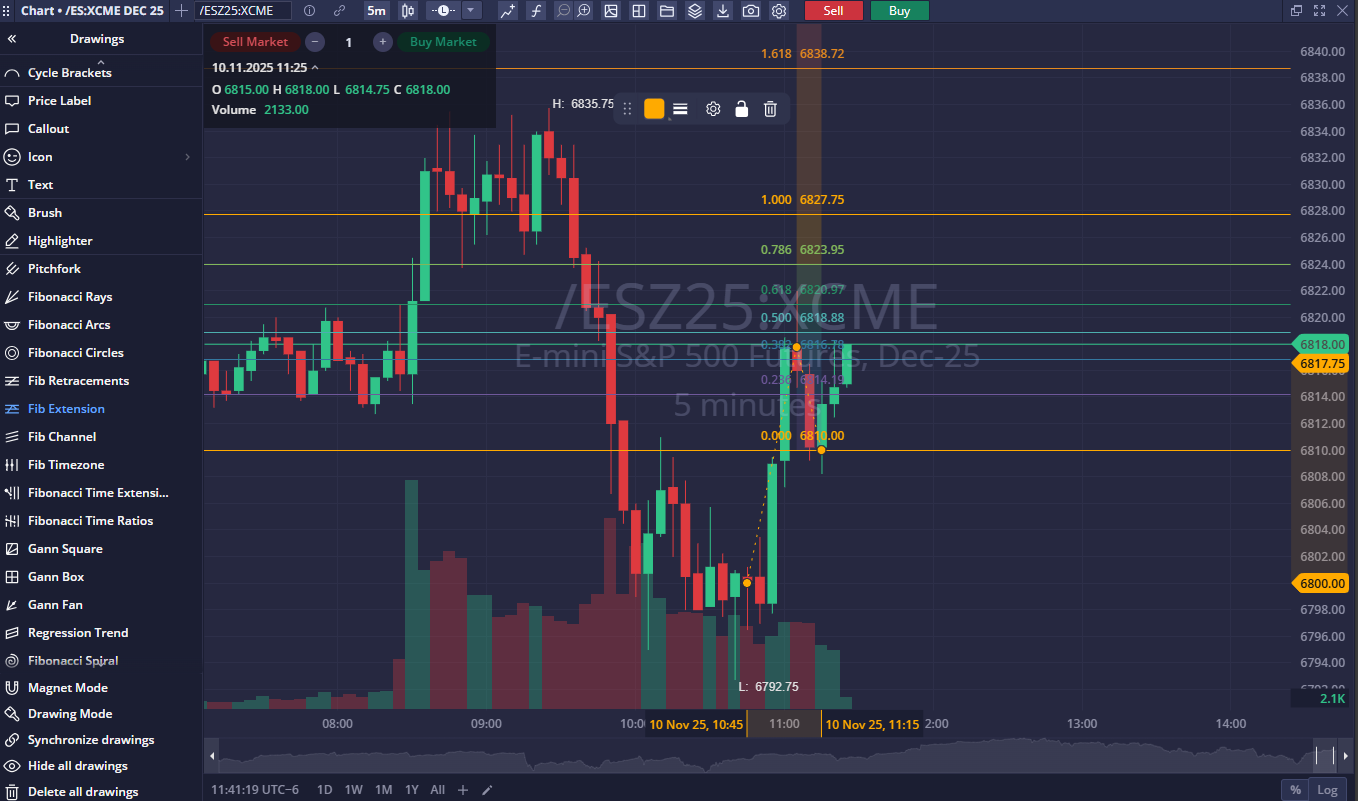
Extensions allow you to estimate how far price may move once the pullback is over and the trend resumes. They are commonly used to set profit targets or trail stops beyond a recent swing high or low.
How to apply extensions:
- Start with a completed move: swing low to swing high
- Add the third point at the pullback low
- Use the projected levels (like 127.2%, 161.8%, or 200%) to define potential take-profit zones
This approach is often used in breakout setups or trending markets where previous resistance has been cleared and there are no obvious levels to target.
Using Fibonacci Bollinger Bands
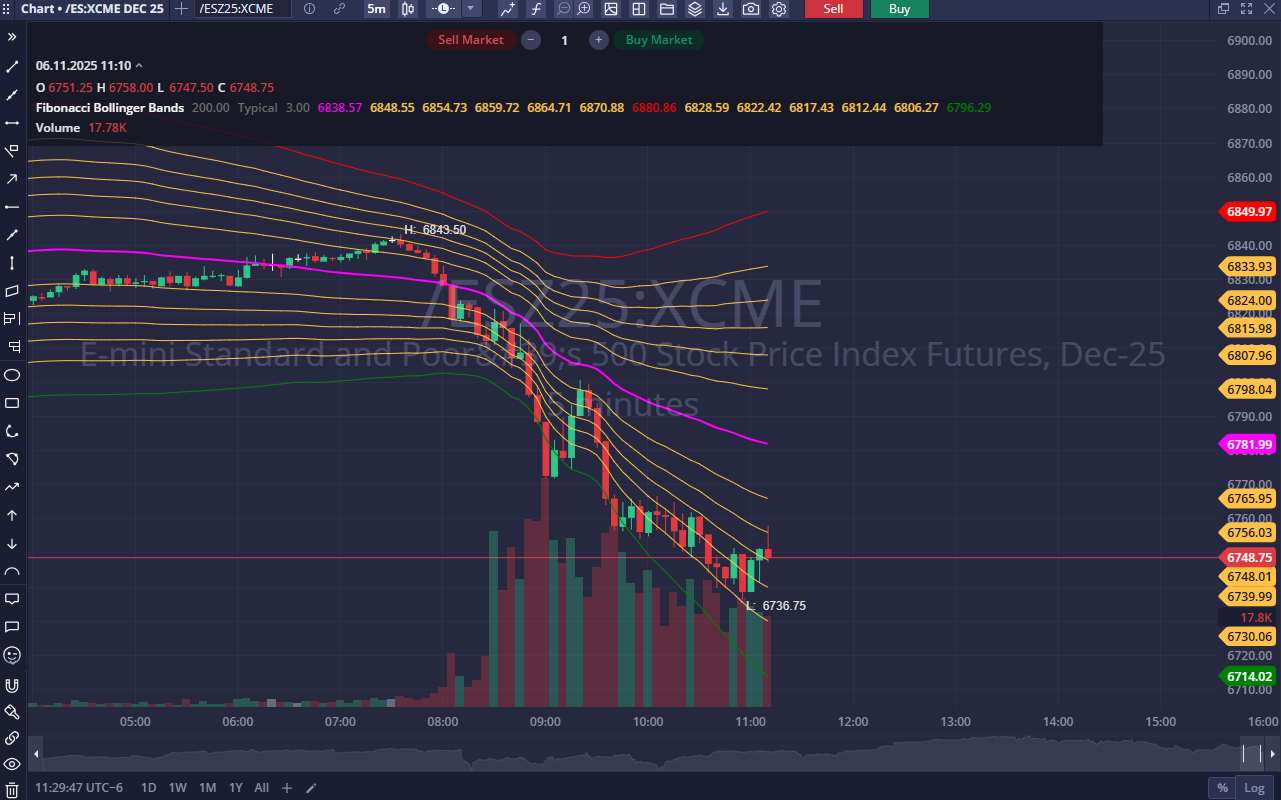
Fibonacci Bollinger Bands are a unique study available on the MetroTrader platform. Unlike standard Bollinger Bands, which plot fixed-distance envelopes around a moving average, these bands use Fibonacci multipliers to define dynamic volatility zones.
You can access them from the Studies menu at the top of the chart. Once selected, the settings panel lets you customize:
- Length: Period used for the moving average (default: 200)
- Price type: The Typical price is commonly used
- Multiplier: Determines the spread of the bands (default: 3)

The bands are plotted at Fibonacci-derived levels both above and below the moving average, such as:
- 0.236-U / 0.236-L
- 0.382-U / 0.382-L
- 0.5-U / 0.5-L
- 0.618-U / 0.618-L
- 1.0-U / 1.0-L
These lines are color-coded in MetroTrader for easy visualization. For example:
- Pink: Center moving average
- Gold: Mid-range Fibonacci bands
- Red / Green: Outer envelope extremes
How to trade with Fibonacci Bollinger Bands
- Trend-following: Use pullbacks to inner bands (like 0.382 or 0.5) to potentially enter in the direction of the trend
- Reversal setups: Watch for price stalling or rejecting the 0.764 or 1.0 bands with high volume
- Volatility compression: When the bands narrow, it may signal a pending breakout
Fibonacci Bollinger Bands are especially helpful for visualizing volatility zones, giving traders a more flexible and layered look at how price reacts around a moving average.
Best Practices When Using Fibonacci Tools
- Always draw from clear swing points to avoid misleading levels
- Use Fibonacci tools in conjunction with trendlines, support/resistance, or volume indicators
- Don’t treat Fibonacci levels as exact prices — think of them as zones of interest
- Test your setups using MetroTrader’s simulated trading environment before risking capital
Fibonacci Trading Strategies for Beginners
Here are four basic strategies you can test:
1. Trend Retracement Strategy
- Wait for a pullback to the 38.2% or 61.8% retracement in an uptrend
- Enter on confirmation (like a bullish candle or bounce)
- Place stop below the swing low and target the previous high or extension level
2. Breakout Extension Strategy
- After a breakout, use the 127.2% or 161.8% level as a price target
- Combine with strong volume or momentum for confirmation
3. Confluence Strategy
- Look for overlapping levels between Fibonacci retracements and other signals (like trendlines or moving averages)
- Confluence adds strength to the setup
4. Scalping Strategy
- On short timeframes (1m or 5m), apply Fibonacci to recent moves
- Look for quick bounces off the 23.6% or 38.2% levels
- Tight stops and quick exits are key
Test Your Futures Trading Strategy
Start your live trading application and begin with margins as low as $80 per contract.
Common Mistakes with Fibonacci Tools
Avoid these beginner errors:
- Forcing it on a bad price structure: Many traders apply Fibonacci retracements or extensions to messy, sideways markets where there are no clear swing highs or lows, which results in misleading signals.
- Treating Fibonacci levels as exact numbers: Price rarely reverses at a precise level; instead, it tends to react within a zone around the retracement or extension line, so you should allow for some flexibility.
- Skipping stop-loss placement or risk management: Just because a price touches a Fibonacci level doesn’t mean it will reverse, so every trade should have a defined stop to manage potential losses.
- Overloading charts with too many levels: Plotting multiple Fibonacci tools on the same chart can lead to confusion; stick to the most recent or most relevant swings to maintain clarity.
Best Practices for Fibonacci Trading
Begin your analysis with the trend direction in mind.
Always determine whether the market is trending up or down before applying Fibonacci tools, so you know whether to look for retracements or extensions.
Use Fibonacci tools to plan trades in advance, not react to moves.
Plot your retracement or extension levels before entering a trade to create a structured plan with defined entries, exits, and stop-loss zones.
Focus on one high-quality setup at a time.
Instead of plotting Fibonacci levels on every swing, concentrate on setups that align with strong price structure and clean directional movement.
Let the market come to your level.
Wait for price to interact with a Fibonacci zone and show a clear reaction, rather than entering too early out of anticipation or fear of missing out.
Final Thoughts: Is Fibonacci Right for You?
Fibonacci tools give structure to your trading. They’re simple to apply, highly visual, and widely used. While they won’t predict the market with certainty, they can help you plan smarter entries and exits.
Start by practicing in a MetroTrader demo trading account using tools like Fibonacci retracements, extensions, and Fibonacci Bollinger Bands. Over time, you’ll build confidence using them as part of your strategy.
FAQs
What is Fibonacci trading in futures?
Fibonacci trading in futures involves using retracement and extension levels based on the Fibonacci sequence to identify support, resistance, and price targets. Traders apply these levels to swing highs and lows to plan entries, exits, and manage risk.
How do you draw Fibonacci retracement levels on a chart?
To draw Fibonacci retracement levels, connect a swing low to a swing high in an uptrend or a swing high to a swing low in a downtrend. Most charting platforms will automatically display common levels like 38.2%, 50%, and 61.8%.
What are the best Fibonacci levels for beginners to use?
The best Fibonacci levels for beginners are 38.2%, 50%, and 61.8%. These are commonly used in technical analysis to identify high-probability support or resistance zones during pullbacks.
Is Fibonacci trading reliable in futures markets?
Fibonacci tools can be effective in trending markets, especially when used with other indicators or price action signals. Like any strategy, they should be tested and confirmed before relying on them for live trades.
What’s the difference between Fibonacci retracement and extension?
Fibonacci retracement levels measure how far a market pulls back within a trend, while extension levels project how far price may move once the trend resumes. Both tools are used to plan entries and exits in futures trading.
What are Fibonacci Bollinger Bands, and how are they used?
Fibonacci Bollinger Bands are a technical analysis study that applies Fibonacci ratios to standard Bollinger Bands. On MetroTrader, these bands help visualize dynamic support and resistance zones based on volatility, trend strength, and key Fibonacci levels.
The content provided is for informational and educational purposes only and should not be considered trading, investment, tax, or legal advice. Futures trading involves substantial risk and is not suitable for every investor. Past performance is not indicative of future results. You should carefully consider whether trading is appropriate for your financial situation. Always consult with a licensed financial professional before making any trading decisions. MetroTrade is not liable for any losses or damages arising from the use of this content.