

Knowing what an option is and knowing how to calculate your profit or loss on one are two different things. Many traders can define a call or a put but still find themselves unsure about exactly when they make money, when they lose it, and how much.
This guide focuses specifically on the profit and loss mechanics of buying options on futures. It covers how P&L works for long calls and long puts, what determines your outcome before and at expiration, and the common mistakes that lead traders to misread their results.
Key Takeaways
- The most you can lose when buying an option on futures is the premium you paid. Unlike trading the underlying futures contract, long options have a defined, fixed maximum loss from the moment you enter the trade.
- Profit on a long option depends on how much the option gains in value relative to what you paid for it. Your break-even is not just the strike price; it also includes the premium you paid to enter.
- A long call profits when the underlying futures price rises above the break-even price, and a long put profits when it falls below it. Direction alone is not enough; the move has to be large enough to cover the cost of the premium.
- Time decay works against long option holders. An option can be directionally correct but still lose value if the expected move takes too long to develop.
- You do not have to hold to expiration. Long options can be sold before expiration to lock in a gain or limit a loss based on the option’s current market value.
What Determines P&L When You Buy an Option on Futures
When you buy an option on a futures contract, your profit or loss comes down to one straightforward comparison: what you paid for the option versus what it is worth when you exit.
The premium you pay at entry is your cost basis. It is fixed. It does not change regardless of what the market does after you enter. That premium is also your maximum loss. If the option expires worthless, you lose the premium and nothing more.
From there, P&L is calculated as:
P&L = Current Option Value minus Premium Paid
If the option is worth more than what you paid, you have a gain. If it is worth less, you have a loss. If it expires with no value, you lose the full premium.
The Role of Premium as Your Cost Basis
Premium is the price you pay to buy the option. It reflects the market’s current assessment of the option’s value, which includes whether the option is in the money, how much time remains, and how volatile the underlying futures contract is.
For a deeper look at how premium is priced and what drives it, see Options on Futures: Strike Price, Expiration, and Premium Explained.
What matters for P&L purposes is this: the premium sets the threshold you need to clear before you are profitable. Buying a cheap option is not automatically a good trade, and buying an expensive option is not automatically a bad one. What matters is whether the option gains enough value relative to what you paid.
P&L for Long Call Options on Futures
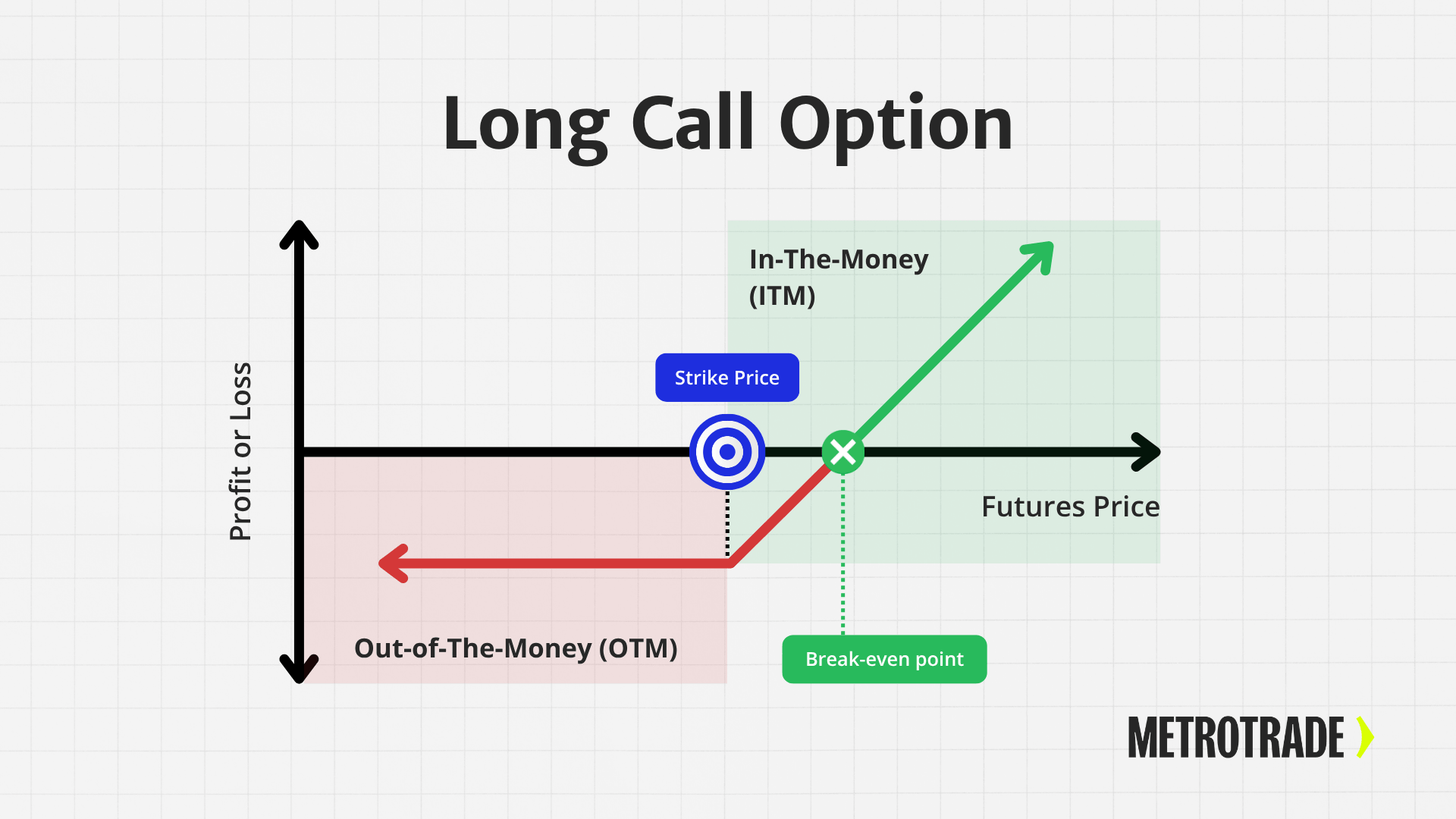
A long call gives you the right to buy a futures contract at a specific strike price before expiration. You buy a call when you expect the underlying futures price to rise.
For a long call to be profitable at expiration, the underlying futures price must be above the strike price by more than the premium you paid. That total is your break-even price.
Break-even at expiration = Strike price + Premium paid
Profit at expiration = (Underlying futures price minus Strike price minus Premium paid) x Contract multiplier
If the futures price is below the strike at expiration, the call expires worthless, and you lose the full premium. If it is between the strike and the break-even, the option has some value, but not enough to cover your cost. You recover part of the premium but still have a net loss. Above the break-even, you are profitable.
Long Call Example: ES Futures
Suppose you buy a call option on the E-mini S&P 500 (ES) futures contract. The ES is currently trading at 5,200. You buy a call with a strike price of 5,220, paying a premium of 15 points. Each point in ES is worth $50, so your total premium cost is $750 (15 x $50).
Here is how the P&L looks under three scenarios at expiration:
- ES settles at 5,200 (below strike): The option expires worthless. You lose the full $750 premium.
- ES settles at 5,230 (above strike, below break-even): The option has 10 points of intrinsic value, worth $500. You paid $750, so your net loss is $250. You recovered part of the premium but did not break even.
- ES settles at 5,250 (above break-even of 5,235): The option has 30 points of intrinsic value, worth $1,500. You paid $750, so your net profit is $750.
The break-even in this example is 5,220 + 15 = 5,235. ES needs to close above that level at expiration for the trade to produce a net gain.
What Happens to a Long Call Before Expiration
Before expiration, the P&L calculation works the same way in principle, but the option’s value is not based solely on how far it is in the money. It also reflects time remaining and implied volatility.
This means the option’s value can increase or decrease even when the futures price is moving in your direction, because the other components of its value are shifting at the same time. For a more detailed breakdown of these components, see Options on Futures: Value of an Option Explained (ITM, OTM, and ATM).
For P&L purposes, what you need to know is:
- Early exit P&L = Premium received on close minus Premium paid on entry
- If you paid $750 to buy the call and you sell it for $1,100 before expiration, your profit is $350, regardless of where the strike price is relative to the futures price.
- If the option has lost value and is now trading at $400, selling it produces a $350 loss, but you avoided losing the remaining $400.
Exiting early gives you the ability to manage P&L without waiting for expiration to determine your outcome.
P&L for Long Put Options on Futures
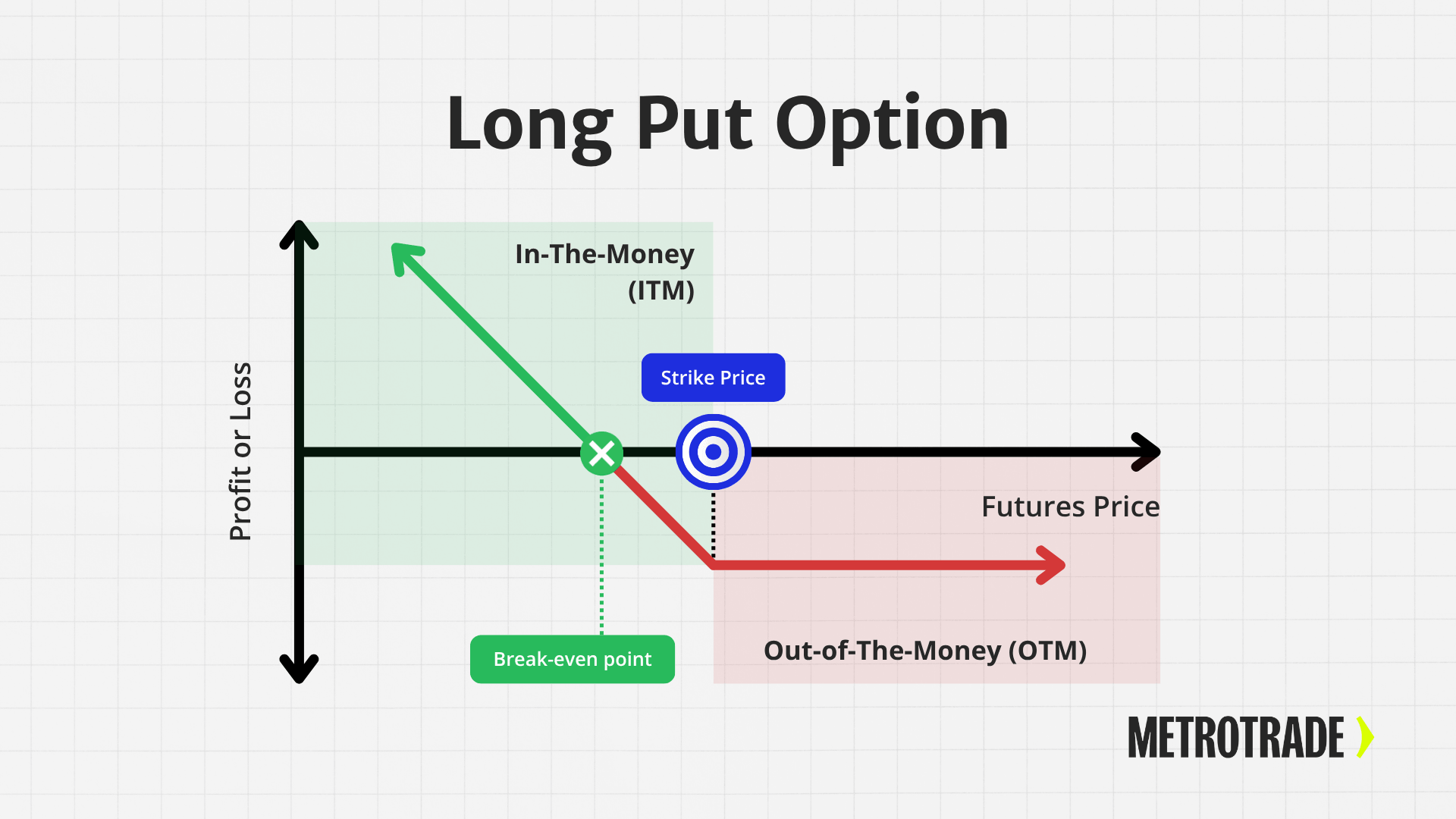
A long put gives you the right to sell a futures contract at a specific strike price before expiration. You buy a put when you expect the underlying futures price to fall.
For a long put to be profitable at expiration, the underlying futures price must be below the strike price by more than the premium you paid.
Break-even at expiration = Strike price minus Premium paid
Profit at expiration = (Strike price minus Underlying futures price minus Premium paid) x Contract multiplier
If the futures price is above the strike at expiration, the put expires worthless and you lose the full premium. If it is between the break-even and the strike, you recover some premium but still have a net loss. Below the break-even, the trade is profitable.
Long Put Example: GC Futures
Suppose you buy a put option on Gold futures (GC). Gold is currently trading at $2,350 per troy ounce. You buy a put with a strike price of $2,330, paying a premium of $18 per ounce. Each GC contract covers 100 troy ounces, so your total premium cost is $1,800 (18 x $100).
Here is how the P&L looks under three scenarios at expiration:
- GC settles at $2,360 (above strike): The put expires worthless. You lose the full $1,800 premium.
- GC settles at $2,315 (below strike, above break-even of $2,312): The put has $15 of intrinsic value per ounce, worth $1,500. You paid $1,800, so your net loss is $300. The move was in your direction, but not large enough to cover the premium.
- GC settles at $2,290 (below break-even): The put has $40 of intrinsic value per ounce, worth $4,000. You paid $1,800, so your net profit is $2,200.
The break-even in this example is $2,330 minus $18 = $2,312. Gold needs to close below that level at expiration for the trade to produce a net gain.
What Happens to a Long Put Before Expiration
The same logic that applies to long calls before expiration applies to long puts. Option value before expiration reflects more than just how far the futures price has moved. Time remaining and implied volatility are also factors.
- If you paid $1,800 for the put and it is now trading at $2,600 because gold has dropped sharply, you can sell it and lock in an $800 gain without waiting for expiration.
- If gold has moved sideways and time has eroded the option’s value to $900, you can sell it and take a $900 loss rather than risk losing the remaining value.
Early exits give you flexibility to manage outcomes that would otherwise be determined entirely by where the futures price sits at expiration.
Maximum Loss, Maximum Gain, and Break-Even
The table below summarizes the key P&L boundaries for long calls and long puts on futures.
|
Long Call |
Long Put |
|
|
Maximum loss |
Premium paid |
Premium paid |
|
Maximum gain |
Unlimited (futures price can rise indefinitely) |
Strike price minus premium (futures cannot go below zero) |
|
Break-even at expiration |
Strike + Premium |
Strike minus Premium |
|
Profitable when… |
Futures price > Strike + Premium |
Futures price < Strike minus Premium |
A few notes on this framework:
- Max loss is fixed for both. This is one of the structural differences between buying options and trading the underlying futures contract directly, where losses are not capped.
- Long calls have theoretically unlimited upside because there is no ceiling on how high a futures price can rise.
- Long puts have a defined maximum gain because a futures price cannot fall below zero. In practice, the maximum profit on a long put is reached if the underlying futures contract goes to zero, which is not a realistic scenario for most contracts but sets the mathematical boundary.
MetroTrade currently supports long calls and long puts on CME-listed contracts, including the E-mini S&P 500 (ES), E-mini Nasdaq-100 (NQ), Crude Oil (CL), and Gold (GC).
How Time Affects P&L
Time decay is one of the most important factors to understand when holding a long option. As expiration approaches, an option loses value from the passage of time alone, assuming everything else stays constant.
This works against long option holders. You are not just betting on price direction. You are also betting that the move happens fast enough to offset the value the option loses every day it sits open.
Here is how this plays out in practice:
- You buy a call on ES with 30 days to expiration. ES moves in your direction slowly over two weeks, but does not reach your break-even. By the time it gets close, the option has lost significant time value and is worth less than it was when you entered.
- You buy a put on GC expecting a sharp selloff. Gold drops quickly within the first week; the option gains more value than it loses to time, and you exit with a profit before expiration.
The speed and size of the move matter just as much as the direction.
Pro tip: Options with more time until expiration cost more in premium but decay more slowly, giving the trade more room to develop.
Holding to Expiration vs. Exiting Early
Long option holders have a choice at any point before expiration: hold the position or exit by selling the option back at its current market price. These two paths produce different P&L outcomes.
Holding to expiration:
- If the option expires out of the money, it has no value. You lose the full premium.
- If the option expires in the money, it is settled at its intrinsic value. Your net P&L is intrinsic value minus premium paid.
- There is no middle ground. The final result is determined entirely by where the futures price sits at expiration relative to the strike.
Exiting before expiration:
- P&L is based on the current market value of the option, not intrinsic value alone.
- You may be able to sell an in-the-money option for more than its intrinsic value if time value is still present, improving your exit price.
- You can cut a losing position before the full premium is gone, recovering some of your cost.
When early exit tends to make sense:
- Locking in a gain: If the option has appreciated significantly and expiration is still weeks away, time decay could erode a portion of that gain. Exiting captures it.
- Cutting a loss: If the trade is moving against you and the option still has market value, selling it recovers more than waiting for a worthless expiration.
- Reducing exposure: If conditions change and the original trade thesis no longer holds, exiting early removes the risk without waiting.
There is no universal rule about when to exit versus hold. It depends on the size of the gain, how much time remains, and whether the original reason for the trade is still valid.
Common Mistakes When Calculating P&L on Options on Futures
Even traders who understand the basics of options can make errors when evaluating whether a trade is working. These are the most common ones.
- Forgetting to include the premium in the break-even calculation. An option being in the money does not mean the trade is profitable. If you paid 15 points of premium on an ES call with a 5,220 strike, you need ES above 5,235 to break even, not 5,220.
- Confusing in the money with profitable. An option can be in the money and still produce a net loss if its intrinsic value is less than the premium paid. For a fuller explanation of ITM, OTM, and ATM, see Options on Futures: Value of an Option Explained.
- Ignoring time decay on longer-duration trades. Buying an option with several weeks until expiration and expecting a slow, gradual move can result in a loss even if the direction was correct. The move needs to outpace the daily erosion of time value.
- Waiting for expiration when early exit makes more sense. Some traders hold positions hoping for a recovery when the trade has already moved meaningfully against them, and time is accelerating the loss. Selling the option while it retains market value is often the better outcome.
- Misjudging the contract multiplier. Premium is quoted per unit, not per contract. One GC options contract covers 100 troy ounces. A $20 premium means $2,000 in total cost, not $20. Always confirm the contract multiplier before sizing a position.
Conclusion
For long options on futures, profit and loss come down to a simple comparison: what the option is worth when you exit versus what you paid to enter. The premium paid is your maximum loss and your cost basis. Your break-even at expiration is the strike price adjusted by that premium. And your profit depends on the underlying futures price moving far enough, fast enough, in the right direction.
Understanding the difference between being in the money and being profitable, and knowing how time decay affects the trade while it is open, gives you a much clearer picture of what your position is actually doing at any given moment.
MetroTrade offers long calls and long puts on CME-listed futures contracts, including ES, NQ, CL, and GC. If you’re ready to start trading options on futures, open an account today and request access.
Frequently Asked Questions
What is the maximum loss when buying an option on futures?
The maximum loss is limited to the premium paid at entry. If the option expires worthless, you lose the full premium and nothing more. This is one of the defining characteristics of buying options compared to trading the underlying futures contract directly.
How do you calculate profit on a long call option on futures?
At expiration, profit equals the underlying futures price minus the strike price minus the premium paid, multiplied by the contract multiplier. Before expiration, profit equals the current market value of the option minus the premium paid at entry.
How do you calculate profit on a long put option on futures?
At expiration, profit equals the strike price minus the underlying futures price minus the premium paid, multiplied by the contract multiplier. Before expiration, the same rule applies as with calls: current option value minus premium paid.
What is the break-even price for a long options on futures position?
For a long call, break-even at expiration is the strike price plus the premium paid. For a long put, it is the strike price minus the premium paid. The underlying futures price must reach that level at expiration for the trade to produce a net gain.
Can you lose more than the premium paid when buying options on futures?
No. When you buy an option, your loss is capped at the premium you paid. You cannot lose more than that amount, regardless of how far the market moves against you.
How does time decay affect the P&L of a long options on futures position?
Time decay reduces the value of an option as expiration approaches, assuming no change in the underlying price or volatility. This works against long option holders because the option needs the underlying futures to move far enough, fast enough, to offset the value lost to time each day.
What happens to a long option on futures if it expires out of the money?
If the option expires out of the money, it has no value, and the position closes with a full loss equal to the premium paid. There is no recovery of any portion of the premium in this scenario.
Should you hold options on futures to expiration or exit early?
It depends on the trade. Exiting early allows you to lock in gains before time decay erodes them, or to cut losses while the option still has market value. Holding to expiration makes sense when the trade is moving strongly in your favor and exiting early would leave significant potential profit on the table.
The content provided is for informational and educational purposes only and should not be considered trading, investment, tax, or legal advice. Futures trading involves substantial risk and is not suitable for every investor. Past performance is not indicative of future results. You should carefully consider whether trading is appropriate for your financial situation. Always consult with a licensed financial professional before making any trading decisions. MetroTrade is not liable for any losses or damages arising from the use of this content.
Transactions in options carry a high degree of risk. Purchasers and sellers of options should familiarize themselves with the type of option (i.e. put or call) which they contemplate trading and the associated risks. You should calculate the extent to which the value of the options must increase for your position to become profitable, taking into account the premium and all transaction costs. The purchaser of options may offset or exercise the options or allow the options to expire. The exercise of an option results either in a cash settlement or in the purchaser acquiring or delivering the underlying interest. If the option is on a future, the purchaser will acquire a futures position with associated liabilities for margin (see the section on Futures above). If the purchased options expire worthless, you will suffer a total loss of your investment, which will consist of the option premium plus transaction costs. If you are contemplating purchasing deep out-of-the-money options, you should be aware that the chance of such options becoming profitable ordinarily is remote. Selling (‘writing’ or ‘granting’) an option generally entails considerably greater risk than purchasing options.
Although the premium received by the seller is fixed, the seller may sustain a loss well in excess of that amount. The seller will be liable for an additional margin to maintain the position if the market moves unfavorably. The seller will also be exposed to the risk of the purchaser exercising the option, and the seller will be obligated to either settle the option in cash or to acquire or deliver the underlying interest. If the option is on a future, the seller will acquire a position in a future with associated liabilities for margin (see the section on Futures above). If the position is ‘covered’ by the seller holding a corresponding position in the underlying interest or a future or another option, the risk may be reduced. If the option is not covered, the risk of loss can be unlimited. Certain exchanges in some jurisdictions permit deferred payment of the option premium, exposing the purchaser to liability for margin payments not exceeding the amount of the premium. The purchaser is still subject to the risk of losing the premium and transaction costs. When the option is exercised or expires, the purchaser is responsible for any unpaid premiums outstanding at that time.