


Every time you place a trade, liquidity is working either for you or against you. It determines how quickly your order gets filled, how close that fill is to the price you expected, and how much the bid-ask spread costs you before you even factor in commissions.
Most new futures traders focus on strategy, indicators, and margin requirements. Liquidity often gets overlooked until a bad fill or an unexpectedly wide spread makes its impact impossible to ignore.
This guide explains what liquidity means in futures markets, how it affects your trading in practical terms, which contracts offer the most of it, and how to avoid the common mistakes that come from trading in thin market conditions.
Key Takeaways
- Liquidity measures how easily a futures contract can be bought or sold without moving the price, and it directly affects your fill quality, spread costs, and overall transaction efficiency.
- Low liquidity leads to wider bid-ask spreads and more slippage, meaning you pay more to enter and exit trades even before commissions are factored in.
- A small group of futures contracts accounts for the majority of market liquidity, including the E-mini S&P 500 (ES), Crude Oil (CL), and Gold (GC).
- Liquidity peaks during the US trading session, especially between 8:30 AM and 11:30 AM ET, and drops significantly during overnight hours and holiday periods.
- Checking volume, bid-ask spread, and market depth before placing a trade helps you avoid entering into conditions that increase cost and risk.
What Is Liquidity in Futures Trading?
Liquidity refers to how easily a futures contract can be bought or sold at a stable price. A highly liquid market has many buyers and sellers active at any given moment. Orders fill quickly, prices move smoothly, and the cost of entering and exiting is low.
A market with low liquidity has fewer participants. Orders may not fill at the expected price, spreads widen, and even moderate-sized trades can push the market against you.
In futures trading, liquidity is not a fixed quality. It varies by contract, time of day, and market conditions. Understanding those variations is part of trading well.
Bid-Ask Spread Explained
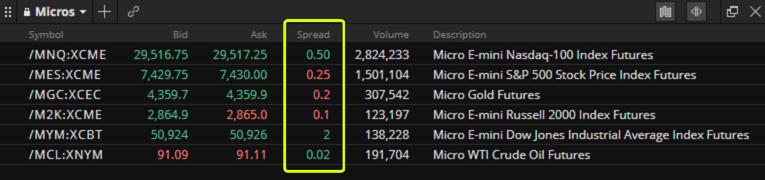
The bid-ask spread is the gap between the highest price a buyer is willing to pay (the bid) and the lowest price a seller is willing to accept (the ask). It is the most direct measure of liquidity you will encounter as a trader.
When you buy at the market, you pay the ask. When you sell at market, you receive the bid. That gap is an immediate cost on every trade, separate from commissions.
In a highly liquid market like the E-mini S&P 500 (ES), the bid-ask spread is typically just one tick, or $12.50 per contract. In a thinly traded market, that spread can widen to several ticks, adding meaningful cost to every entry and exit. A trader placing ten round-trip trades per day would feel that difference significantly over the course of a week.
Market Depth and the Order Book
Market depth refers to the number of buy and sell orders sitting at each price level in the order book at any given moment. A deep market has large quantities of contracts available at prices close to the current price. A shallow market has fewer orders, which means the price can move quickly if a moderately sized order comes in.
Most trading platforms, including MetroTrader, include a Depth of Market (DOM) tool, also called a trading ladder. The DOM shows you the live order book: how many contracts are resting at each bid and ask level. Before entering a trade, experienced traders often check the DOM to assess whether the market has enough depth to support their order at an acceptable price.
A DOM that shows hundreds or thousands of contracts stacked at each level indicates strong liquidity. One showing only a handful of contracts at each level is a warning sign that your fill may not come in at the price you expect.
How Liquidity Affects Your Trades
Understanding liquidity in theory is one thing. Seeing how it plays out in your actual trading results is another. Liquidity affects three specific outcomes that directly impact your bottom line: slippage, transaction costs from wider spreads, and the price impact of your orders.
Slippage
Slippage occurs when your order fills at a different price than you intended. It is most common when using market orders in fast-moving or low-liquidity conditions.
Imagine you place a market buy order expecting to fill at 5,250.00 on the ES. In a liquid market with deep order flow, you fill at or very close to that price. In a thinly traded market, or during a fast spike in volatility, the available contracts at 5,250.00 may be gone by the time your order reaches the exchange. You end up filling at 5,250.50 or higher, paying more than planned.
Slippage feels small on any single trade. Across dozens of trades per week, it adds up. For active traders, managing slippage is as important as managing commissions.
Spreads and Transaction Costs
The bid-ask spread is a cost that exists on top of your broker’s commission. In liquid markets, this cost stays tight and predictable. In illiquid ones, it can become a significant drag on performance.
Consider a contract with a two-tick spread versus a one-tick spread. On a single round trip, you are paying one additional tick on the way in and potentially another on the way out. For a contract like the ES where one tick equals $12.50, a two-tick spread costs $25 more per round trip compared to a one-tick spread.
Traders who place multiple trades per day in thin markets often underestimate how much spread cost is eroding their results. High-liquidity contracts like ES and MES tend to maintain tight spreads consistently during peak trading hours, which is one reason they are popular with active intraday traders.
Price Impact of Large Orders
In a deep, liquid market, a single retail-sized order has essentially no impact on price. There are enough resting orders at each level to absorb the trade cleanly.
In a shallow market, the same order can eat through multiple price levels in the order book, causing the price to move against you as your order fills. This is called market impact, and it becomes increasingly relevant as a trader scales up position size.
Institutional traders and larger funds manage this problem constantly, which is why they favor the most liquid contracts available. For retail traders, the takeaway is practical: if you are increasing your position size, make sure the market you are trading has the depth to absorb it without adverse fills.
Most Liquid Futures Contracts
Liquidity in futures markets is not evenly distributed. A relatively small number of contracts account for the vast majority of daily trading volume. Focusing on these markets keeps your transaction costs low and your fills reliable.
Equity Index Futures
Equity index futures are the most liquid category in the retail futures market.
- ES (E-mini S&P 500): The ES is consistently one of the most actively traded futures contracts in the world. It offers tight spreads, deep order books, and strong participation throughout the US session. For traders who focus on index futures, ES is typically the starting point.
- MES (Micro E-mini S&P 500): The MES is one-tenth the size of the ES and carries a fraction of the margin requirement. Despite its smaller size, it benefits from the same deep liquidity pool as ES, making it one of the most accessible liquid contracts for smaller accounts.
- NQ (E-mini Nasdaq-100) and MNQ (Micro Nasdaq-100): NQ is more volatile than ES and tends to make larger intraday moves. Both NQ and its micro counterpart MNQ carry strong liquidity during US session hours, making them popular for traders who prefer tech-heavy index exposure.
Energy Futures
- CL (Crude Oil): Crude oil futures are among the most actively traded commodity futures globally. CL sees strong participation from commercial hedgers, institutional traders, and retail speculators, particularly during the London-New York overlap. The contract moves frequently on geopolitical news, inventory reports, and macroeconomic data.
Energy contract intraday margins can vary significantly based on market conditions, so checking current margin requirements before trading CL is advisable.
Metals Futures
- GC (Gold): Gold futures offer strong liquidity, with activity peaking around US economic data releases and during periods of macro uncertainty. GC is popular with both shorter-term traders and swing traders who follow macro trends.
- MGC (Micro Gold): The micro gold contract is one-tenth the size of GC and provides similar liquidity characteristics at a more accessible scale, making it a practical choice for traders building experience with metals markets.
Other Highly Liquid Contracts
Several other markets offer strong liquidity depending on your trading focus:
- ZN (10-Year Treasury Note) and ZB (30-Year Treasury Bond): These interest rate futures are highly active, especially around Federal Reserve announcements, CPI releases, and Non-Farm Payrolls data.
- Euro FX (6E) and British Pound (6B): Currency futures that attract strong participation during European session hours and the London-New York overlap. Useful for traders who follow central bank policy and macroeconomic trends.
When Liquidity Is Highest (and Lowest)
Even within a liquid contract, liquidity changes throughout the trading day. Entering a trade at the wrong time can expose you to wider spreads and less reliable fills, even if the contract you are trading is generally considered highly liquid.
High-Liquidity Windows
The best liquidity conditions in US futures markets typically occur during the following windows:
- 8:30 AM to 11:30 AM ET: This is the core of the US trading session. The stock market opens at 9:30 AM ET, and the combination of economic data releases, institutional activity, and retail participation creates the deepest, most liquid conditions of the day.
- London-New York overlap (approximately 8:30 AM to 12:00 PM ET): When both European and US traders are active simultaneously, volume and participation spike. Contracts like ES, CL, and GC all see elevated activity during this window.
- Around major economic releases: Events like Non-Farm Payrolls, CPI, and FOMC announcements bring a surge in trading activity. Liquidity increases rapidly around these events, though volatility increases as well.
For more details on how session timing affects different contracts, see Futures Trading Sessions Every Trader Should Know.
Low-Liquidity Periods to Watch
Avoiding thin market conditions is just as important as knowing when conditions are strong:
- Asian session for US-centric contracts: Equity index futures like ES and NQ see significantly lower participation during Asian session hours. Spreads can widen, and price moves may be less orderly.
- Post-US close dead zone (approximately 5:00 PM to 8:00 PM ET): After the US session closes, most institutional and retail traders are offline. Volume drops sharply, and spreads can widen even in otherwise liquid contracts.
- Holidays and reduced-participation days: Federal holidays, the days around Thanksgiving, and the last weeks of December often see thin trading across the board. Fills become less predictable and spreads widen even during normal trading hours.
- Late overnight and pre-market hours: The period between the Asian session close and the European session open is typically the quietest stretch of the trading day for US contracts.
Trading during low-liquidity windows is not necessarily wrong, but it does require adjusting your approach: smaller position sizes, limit orders instead of market orders, and a realistic expectation that fills may not match what you see in peak hours.
How to Identify Liquid vs. Thin Markets
Before placing any trade, a few straightforward checks can tell you whether conditions are favorable or worth waiting on.
Volume as a Liquidity Indicator
Volume measures the total number of contracts traded over a given period. Higher volume means more participants are active, which typically translates to tighter spreads and more reliable fills.
On MetroTrader charts, volume is visible directly below the price action. Comparing current volume to what is typical for that contract and that time of day gives you a quick read on whether conditions are normal, elevated, or thin.
A session where volume is running well below average is a signal to be cautious. Breakouts may not follow through. Spreads may be wider than usual. Orders may not fill as cleanly as expected.
Using the DOM to Gauge Market Depth
The DOM in MetroTrader shows the live order book: the number of contracts available to buy or sell at each price level above and below the current market. Before entering a trade, especially with a market order, glancing at the DOM tells you whether there is enough liquidity to support a clean fill.
In a healthy, liquid market, you will see substantial quantities of contracts resting at each level near the current price. In a thin market, those levels may show only a small number of contracts, which means your order could move through multiple price levels before fully filling.
This is especially relevant for traders using larger position sizes or trading less common contracts outside peak hours.
Spread Monitoring
The bid-ask spread itself is one of the simplest and most reliable real-time indicators of current liquidity. Before entering any trade, check the current spread and compare it to what is normal for that contract.
If you are trading ES and notice the spread has widened to three or four ticks when it is usually one, that is a signal that liquidity conditions have changed. It may be worth waiting a few minutes, especially if you are near a session open, a news event, or a period of unusually low volume.
Common Mistakes Traders Make with Liquidity
Most liquidity-related errors come from not checking conditions before trading, or from applying peak-hour habits to off-hours situations.
- Choosing contracts based on volatility rather than liquidity. A contract that moves a lot is not necessarily one that trades well. Thin contracts can produce wide swings, but filling orders cleanly is a separate problem.
- Using market orders in low-liquidity conditions. Market orders fill at whatever price is available. In thin markets, that can mean significant slippage, especially on larger orders.
- Trading outside peak session hours without adjusting expectations. A strategy that works cleanly during the US session may produce poor fills and unexpected costs if applied during overnight or holiday hours.
- Ignoring spread width before entry. Entering a trade when the spread is unusually wide means starting the trade at an immediate disadvantage.
- Scaling up position size without checking market depth. Adding contracts to your position increases your order’s potential price impact, especially in markets with shallow order books.
Risk Management and Liquidity
Liquidity risk is a recognized category of trading risk. It refers to the possibility that you will not be able to enter or exit a position at an acceptable price because of thin market conditions. Managing this risk is part of any sound trading approach.
Practical steps include:
- Use limit orders in less-liquid conditions. A limit order specifies the price you are willing to accept. It protects you from slippage but does carry the risk of not filling if the market moves away from your level.
- Trade smaller in thin markets. If you choose to trade during off-peak hours or in a less-liquid contract, reducing your position size limits your exposure to adverse fills and wide spreads.
- Stick to highly liquid contracts when starting out. Contracts like MES, MNQ, and MGC offer the same underlying market exposure as their full-size counterparts at a more accessible scale, with the same liquidity benefits.
- Match your contract choice to your account size and strategy. A scalper running ten to twenty trades per day has very different liquidity needs than a swing trader taking two or three positions per week. Choosing contracts with sufficient depth for your specific approach matters more as your activity level increases.
- Build awareness of session timing into your trading plan. Knowing when liquidity peaks and when it drops allows you to be selective about when you execute, rather than treating all market hours as equivalent.
Conclusion
Liquidity shapes every trade you place. It determines how close your fill is to the price you intended, how much you pay in spread costs before commissions, and how much risk you take on when markets are thin.
The most liquid futures contracts, including ES, MES, NQ, CL, and GC, offer consistently tight spreads and reliable fills during peak trading hours. Focusing on these markets, trading during high-volume sessions, and checking volume, spread, and market depth before entering all reduce the cost and risk that come from poor liquidity conditions.
Ready to start trading? Open a MetroTrade account today and access the futures markets with competitive commissions, low intraday margins, and the MetroTrader platform on web and mobile.
Frequently Asked Questions
What does liquidity mean in futures trading?
Liquidity in futures trading refers to how easily a contract can be bought or sold without meaningfully moving the price. A liquid market has many active buyers and sellers, resulting in tight bid-ask spreads, reliable fills, and low slippage. A thin market has fewer participants, which leads to wider spreads and less predictable order execution.
Which futures contracts are the most liquid?
The most liquid futures contracts include the E-mini S&P 500 (ES), Micro E-mini S&P 500 (MES), E-mini Nasdaq-100 (NQ), Crude Oil (CL), and Gold (GC). Interest rate futures like the 10-Year Treasury Note (ZN) and major currency futures like the Euro FX (6E) also carry strong liquidity, especially during their respective peak sessions.
How does low liquidity affect my fills?
In low-liquidity conditions, your orders are more likely to experience slippage, meaning they fill at a worse price than you intended. The bid-ask spread also tends to widen, increasing the immediate cost of each trade. Large orders in thin markets can push the price against you as your order moves through available levels in the order book.
What is slippage, and how do I avoid it?
Slippage is the difference between the price you expected to fill at and the price you actually received. It is most common when using market orders during low-liquidity periods or fast-moving market conditions. Avoiding slippage involves using limit orders when possible, trading during peak session hours, and sticking to highly liquid contracts with deep order books.
What time of day has the best liquidity for futures?
The best liquidity conditions for US futures contracts occur during the US session, particularly from 8:30 AM to 11:30 AM ET. The London-New York overlap, which runs roughly from 8:30 AM to 12:00 PM ET, is especially active. Liquidity drops significantly during overnight hours, the post-US close window, and holiday periods.
How can I tell if a futures market is liquid before trading?
Check three things before entering a trade: current volume compared to the typical level for that time of day, the current bid-ask spread versus what is normal for that contract, and the depth of market using the DOM tool. Thin volume, wide spreads, and a shallow order book are all signs that liquidity conditions are not favorable.
Does liquidity affect micro futures contracts?
Yes, but micro contracts tied to major indices and commodities generally carry strong liquidity. The MES, MNQ, and MGC benefit from the same underlying market depth as their full-size counterparts and trade with consistently tight spreads during peak hours. Less commonly traded micro contracts may not offer the same depth, so checking volume and spread before trading still applies.
The content provided is for informational and educational purposes only and should not be considered trading, investment, tax, or legal advice. Futures trading involves substantial risk and is not suitable for every investor. Past performance is not indicative of future results. You should carefully consider whether trading is appropriate for your financial situation. Always consult with a licensed financial professional before making any trading decisions. MetroTrade is not liable for any losses or damages arising from the use of this content.