

The Pattern Day Trader (PDT) rule is one of the most frustrating restrictions for new and active stock and options traders. If you have a margin account with less than $25,000 and place more than three day trades within five business days, your broker will likely flag you as a pattern day trader and restrict your activity. This rule can block retail traders from building or testing high-frequency strategies unless they have a large account balance.
But there’s a way around it: trading futures.
Futures contracts do not fall under FINRA’s PDT rule, allowing you to day trade as often as you’d like without meeting the $25,000 capital requirement. In this article, we’ll explain how to avoid the PDT rule by switching to futures, why the restriction doesn’t apply to futures accounts, and what to consider before making the move.
Key Takeaways
- You can avoid the PDT rule by trading futures instead of stocks or options. Futures accounts are not subject to the Pattern Day Trader (PDT) rule because they are regulated by the CFTC and NFA, not FINRA.
- Futures trading allows unlimited day trades with no $25,000 account minimum. Unlike stock margin accounts, futures brokers do not impose trade frequency limits or require high balances to stay active.
- Futures offer lower margin requirements and more leverage. Traders can control large positions with relatively small amounts of capital, making futures more accessible to those with smaller accounts.
- Futures are a legal, regulated option for active retail traders. With proper risk management, futures can be a smart way to build and test trading strategies without being held back by PDT restrictions.
What Is the Pattern Day Trader (PDT) Rule?
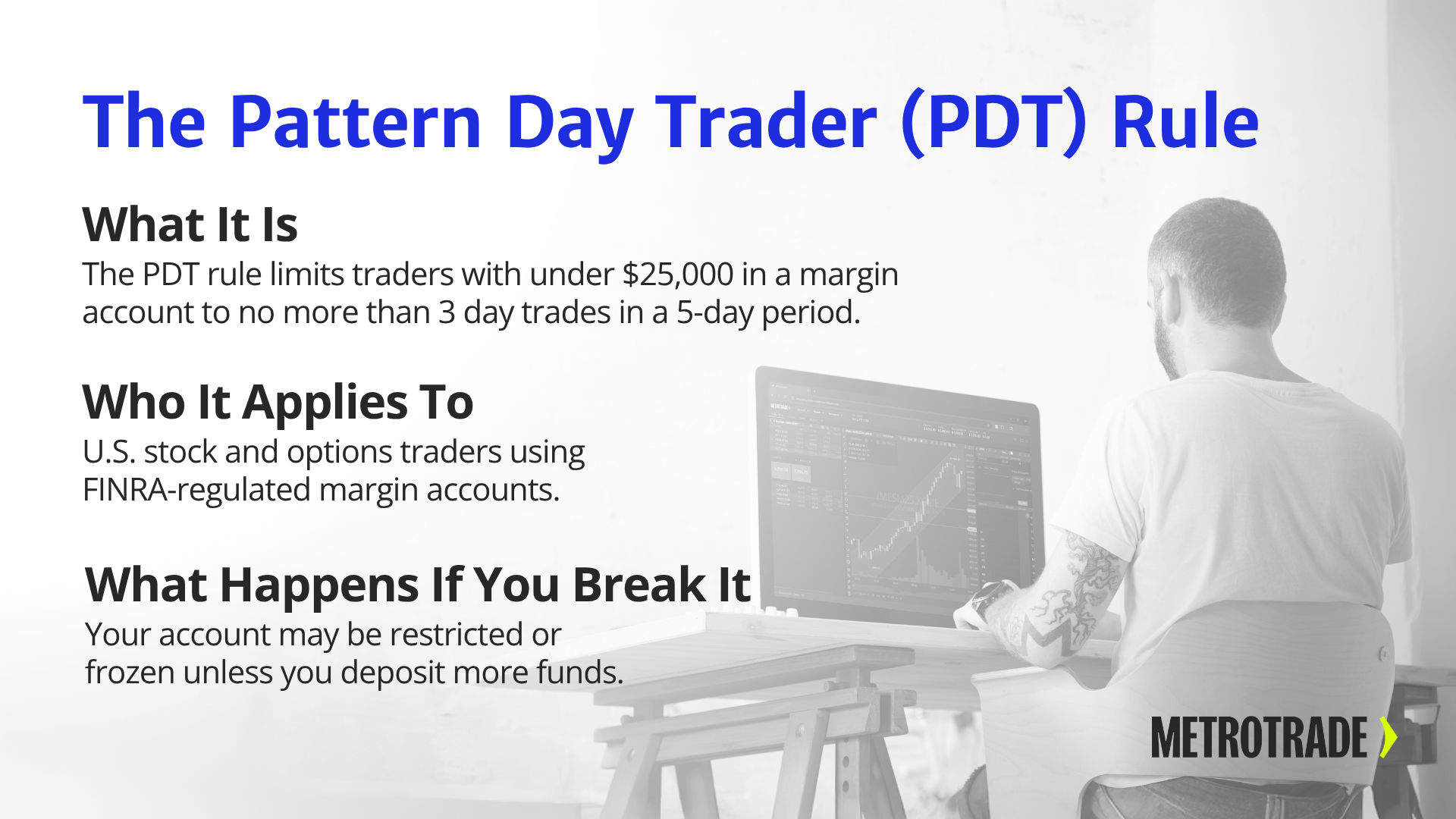
The Pattern Day Trader rule is a FINRA regulation that applies to stock traders using margin accounts. It’s designed to limit high-frequency trading activity in accounts that fall below a certain equity threshold.
What the Rule States
The PDT rule defines a pattern day trader as someone who executes four or more day trades within five business days in a margin account, provided those trades account for more than 6% of the account’s total activity.
If your account is flagged, and you have less than $25,000 in equity, your broker is required to restrict your account. You may be blocked from opening new trades or required to deposit more capital.
What Is a Margin Account?
A margin account is a type of brokerage account that lets you borrow money from your broker to buy and sell securities. This borrowing power—called leverage—increases your buying capacity but also adds risk. Margin accounts are subject to strict rules from regulators like FINRA, including the PDT rule. In contrast, cash accounts require you to pay in full for all trades using only settled funds.
What About Cash Accounts?
Cash accounts are not subject to the PDT rule, but they come with other limitations. Specifically, you must wait for trades to settle—usually one business day (T+1)—before reinvesting the funds. If you attempt to trade using unsettled funds, you may trigger a good-faith violation or freeriding, which can lead to account restrictions or penalties from your broker.
Who the Rule Applies To
The PDT rule affects:
- Traders using margin accounts with FINRA-regulated stock brokers
- U.S. residents trading equities and options
- Traders who engage in frequent intraday trading
It does not apply to:
- Cash accounts (though settlement rules still limit trading frequency)
- Futures accounts, which fall under CFTC/NFA regulation
- Forex or crypto accounts, which have separate risk profiles
What Happens If You Break the Rule
If you violate the PDT rule:
- Your broker may issue a margin call, requiring you to deposit more funds to meet the $25,000 threshold
- You could face a 90-day restriction, during which you can only trade using settled funds
- In some cases, your account could be suspended or downgraded
Why Does the PDT Rule Exist?
The PDT rule was created by FINRA to protect newer retail traders from the risks of excessive day trading. It came into effect after the dot-com bubble, when many inexperienced traders lost large sums of money during volatile market swings.
Regulatory Background
FINRA introduced the rule to:
- Reduce the risk of account blowups from over-leveraging
- Promote responsible use of margin
- Add a barrier to impulsive, high-frequency trading
Arguments For and Against
Supporters say it adds a layer of protection for undercapitalized traders. Critics argue that it unfairly blocks access to intraday strategies and favors those with large account balances. It can be especially frustrating for disciplined traders who simply don’t meet the $25,000 threshold.
How Trading Futures Helps Avoid the PDT Rule
Futures markets are governed by a different set of rules than stocks. That difference is what gives traders a legal workaround to the PDT rule.
Futures Are Not Regulated by FINRA
Futures are regulated by the CFTC and NFA, not FINRA. That means the PDT rule doesn’t apply to futures brokers or traders. There is no cap on the number of trades you can place in a futures account, regardless of account size.
No $25K Minimum Required
Most futures brokers do not require $25,000 to open or maintain an account. In fact, many allow you to trade with as little as $500 to $2,500, depending on the margin requirements of the contracts you’re trading.
Learn how much you need to trade futures
You Can Day Trade as Much as You Want
There are no limitations on intraday trading frequency in a futures account. Whether you make one trade or 100 trades a day, you will not be penalized, flagged, or restricted for “pattern” activity.
Margin Rules: Futures vs Stocks
Understanding how margin works in each market is key to seeing why futures are more flexible for active traders.
Stock Margin Requirements Under PDT
In stock trading:
- Margin accounts allow 2:1 leverage for day trades
- The $25,000 equity minimum must be maintained at all times
- Brokers enforce trade restrictions if you exceed the PDT threshold
Futures Margin Explained
In futures:
- Margin is called a performance bond, not a loan
- You’re not borrowing money, but rather putting up a good-faith deposit
- Intraday margin is often much lower than overnight margin
- Brokers may offer leverage of 10:1 or higher, depending on the contract
This makes futures a more accessible option for traders with limited capital.
How Much Do You Need to Trade Futures vs Stocks?
One of the biggest differences between futures and stock trading is how much capital you need to get started. While stock day trading under the PDT rule requires a minimum of $25,000 in a margin account, futures trading has far lower barriers to entry. Here’s a breakdown to show how much you might need in each market, and what kind of access that capital gives you.
Stock Trading Under the PDT Rule
If you’re trading stocks with a margin account:
- $25,000 minimum: This is the threshold required to avoid being labeled a pattern day trader. If your balance falls below this, your account may be restricted.
- Limited leverage: Most stock brokers offer 2:1 leverage for intraday trades.
- Settlement delays: Even if you’re using a cash account to avoid the PDT rule, you’ll face T+1 settlement times, limiting how often you can trade.
Example:
- You deposit $5,000 in a stock margin account.
- You place four day trades in five business days.
- You get flagged as a PDT and your account is restricted unless you add $20,000 more.
Futures Trading Without the PDT Rule
Futures brokers don’t follow FINRA regulations, so they don’t enforce the PDT rule. You can open a futures account with much less capital, and there are no trade frequency restrictions.
- No $25K requirement: Many futures brokers allow you to start with as little as $1,000–$2,500.
- Intraday margin requirements are much lower: You can trade contracts like Micro E-minis with margins as low as $50–$150.
- Higher leverage: Futures contracts often give you 10:1 or greater exposure compared to your account balance.
Example:
- You deposit $5,000 in a futures account.
- You trade Micro E-mini S&P 500 (MES), which may have an intraday margin requirement of $100.
- You can trade multiple contracts in a single day without triggering any restrictions.
Capital Comparison at a Glance
|
Requirement |
Stock Trading (Margin) |
Futures Trading |
|
Minimum to Avoid PDT |
$25,000 |
No PDT rule applies |
|
Typical Starting Capital |
$25,000+ |
$1,000–$5,000 |
|
Leverage |
~2:1 |
Often 10:1 or higher |
|
Trade Frequency Limitations |
3-day trades in 5 days |
Unlimited |
|
Settlement Delays |
T+1 (cash accounts) |
None |
Why It Matters
For new or active traders with limited capital, futures offer greater flexibility and lower upfront costs. You can day trade actively with a $2,000 account in the futures market, while the same amount wouldn’t even qualify you to place more than three trades in five days under FINRA’s rules.
Start Trading Futures Today
Start your live trading application and begin with margins as low as $80 per contract.
Common Misconceptions About the PDT Rule
“I Can Avoid PDT by Using a Cash Account”
Cash accounts don’t fall under the PDT rule, but they are restricted by the T+1 settlement period. That means funds from a sale may take two business days to become available again. This limits how frequently you can trade.
“I Can Use Multiple Brokerages to Get Around It”
Some traders open multiple accounts at different brokers to spread out their trades. While this can work in the short term, it’s not efficient, and brokers still track trade frequency.
“Crypto and Forex Don’t Have PDT Rules Either”
True, but these markets are often unregulated or loosely regulated and carry additional risks. Futures markets are centralized and regulated, offering more oversight and protection than most crypto or retail forex platforms.
Pros and Cons of Using Futures to Avoid the PDT Rule
Pros:
- No PDT Rule: You can day trade as much as you want.
- Lower Account Minimums: Start trading with far less than $25K.
- Leverage: Control large contract sizes with small capital.
- Tax Efficiency: May qualify for 60/40 tax treatment under Section 1256.
Cons:
- High Leverage = High Risk: Losses can add up quickly.
- Learning Curve: Futures contracts are complex compared to stocks.
- Overnight Risk: Prices can gap against you outside of U.S. trading hours.
Is Futures Trading Right for You?
Switching to futures isn’t for everyone. But if you’re running into the PDT rule and want to day trade with less capital, it might be the right path.
Ideal Candidates
- Traders with less than $25,000 in capital
- Those who want to trade intraday strategies
- Self-directed traders who want to avoid regulatory limits
Who Should Be Cautious
- Traders who are new to leverage
- Anyone unfamiliar with contract specs or margin mechanics
- Those looking to “gamble” instead of building a plan
How To Start Trading Futures
1. Choose a Futures Broker
Not all brokers are created equal. You’ll want a broker that offers:
- Transparent pricing
- Robust trading tools
- Fast execution and support
MetroTrade offers a professional-grade platform called MetroTrader, available on both desktop and mobile. You can start trading on a live account or test your strategies in a demo environment first.
2. Open and Fund an Account
With no $25K minimum, you can start with an amount that fits your risk tolerance. Many traders begin with $1,000 to $5,000, depending on contract type.
3. Practice with a Demo Account
Before you dive in, test-drive the platform with a free 30-day demo account. MetroTrader’s simulated trading tools allow you to explore the interface, place practice trades, and get comfortable with market mechanics.
4. Begin Live Trading with Risk Controls
Once you go live:
- Start with micro contracts (like MES or MNQ)
- Risk only a defined percentage of your account per trade
- Use stop-loss orders and predefined exit rules
Conclusion
The Pattern Day Trader rule can be a major hurdle for aspiring traders with limited capital. But it’s not the only path forward. By trading futures instead of stocks, you can legally avoid the PDT rule, take full control of your trading frequency, and access markets with lower entry barriers and more leverage.
If you’re ready to break free from PDT restrictions, open a free MetroTrade account today and start your application for a live trading account to start your futures journey.
FAQs
What is the PDT rule in day trading?
The Pattern Day Trader (PDT) rule is a FINRA regulation that limits stock traders with less than $25,000 in a margin account to no more than three day trades in a rolling five-business-day period.
How can I avoid the PDT rule?
You can avoid the PDT rule by trading futures instead of stocks. Futures accounts are not subject to FINRA rules and have no trade frequency limits.
Why doesn’t the PDT rule apply to futures trading?
The PDT rule doesn’t apply to futures trading because futures are regulated by the CFTC and NFA, not FINRA. These regulators do not impose trade restrictions based on account size or trading frequency.
Can I day trade every day with a futures account?
Yes, you can place as many day trades as you want in a futures account. There are no pattern day trading restrictions for futures traders.
Do I need $25,000 to start trading futures?
No, you don’t need $25,000 to trade futures. Many brokers allow you to open a futures account with as little as $1,000 to $5,000, depending on the contracts you plan to trade.
Are futures riskier than stocks for day trading?
Futures can be riskier than stocks because they use higher leverage and require fast decision-making. However, with proper risk management, futures offer a flexible alternative for active traders.
The content provided is for informational and educational purposes only and should not be considered trading, investment, tax, or legal advice. Futures trading involves substantial risk and is not suitable for every investor. Past performance is not indicative of future results. You should carefully consider whether trading is appropriate for your financial situation. Always consult with a licensed financial professional before making any trading decisions. MetroTrade is not liable for any losses or damages arising from the use of this content.