

Futures trading rewards preparation. Most traders spend the majority of their time working on entries and exits, but position sizing is what actually determines how much a losing trade costs you. Get the entry wrong, and you can recover. Get the size wrong consistently, and even a solid strategy can drain an account.
Sizing a futures position is more structured than sizing a stock trade. Futures contracts have fixed sizes, fixed tick values, and leverage built in from the start. That means the math matters, and it is worth understanding before you place a trade.
This guide walks through how to calculate futures position size step by step, using real contract examples and a straightforward formula you can apply to any market.
Note: if you’re looking for an easy and quick way to calculate your position size, check out our futures position size calculator.
Key Takeaways
- Futures position sizing starts with the dollar value of each contract and each tick move, not with margin requirements or gut feel.
- A consistent dollar risk per trade anchors every sizing decision and keeps losses predictable across different markets and setups.
- Stop distance in ticks determines risk per contract, which feeds directly into how many contracts you should trade.
- Micro contracts make precise position sizing accessible on smaller accounts, allowing traders to match risk rules without over-sizing.
- Position size should adjust as volatility, stop distances, and account size change, not stay fixed regardless of market conditions.
Why Position Sizing Matters in Futures Trading
In the stock market, you can reduce exposure simply by buying fewer shares. If you want half the risk, you buy half the shares. Futures do not work quite the same way.
Each futures contract has a fixed size, and that size carries real dollar weight. One E-mini S&P 500 (ES) contract, for example, is worth $50 per index point. With the index trading near 7,500, that is roughly $375,000 in notional value controlled by a margin deposit that may be only a few thousand dollars. That leverage is one of the features that makes futures attractive, but it also means that an imprecise approach to sizing can cause significant damage quickly.
Consistent position sizing is what separates traders who stay in the game from those who lose large on a strategy that actually works. It converts a vague risk tolerance into a specific number of contracts, and it does so in a repeatable way.
How Futures Leverage Amplifies Sizing Decisions
Leverage in futures comes from the margin system. To hold one ES contract, a trader might deposit $500 to $1,500 in intraday margin, depending on the broker. But the contract itself reflects the full value of the S&P 500 index multiplied by $50 per point.
A 10-point move in ES equals a $500 gain or loss per contract. A 20-point move equals $1,000. In a market that routinely moves 30 to 60 points in a single session, the dollar impact of holding even one contract is meaningful.
This is why sizing based on margin alone is a mistake. Margin tells you what is required to open a position. It does not tell you how much you stand to lose if the trade moves against you.
Step 1: Know Your Contract’s Dollar Value
Before you can size a position, you need to know what the contract is actually worth per move. That means understanding two key terms: tick size and tick value.
Tick Size and Tick Value Explained
A tick is the minimum price increment a futures contract can move. A tick value is the dollar amount that one tick represents in profit or loss.
These values are set by the exchange and do not change based on your broker or account size. Here are the key contracts you should know:
|
Contract |
Description |
Tick Size |
Tick Value |
|
ES |
E-mini S&P 500 |
0.25 points |
$12.50 |
|
MES |
Micro E-mini S&P 500 |
0.25 points |
$1.25 |
|
NQ |
E-mini Nasdaq-100 |
0.25 points |
$5.00 |
|
MNQ |
Micro E-mini Nasdaq-100 |
0.25 points |
$0.50 |
|
GC |
Gold futures |
0.10 points |
$10.00 |
|
MGC |
Micro Gold futures |
0.10 points |
$1.00 |
Knowing tick value is the foundation. Every position sizing calculation depends on it.
Notional Value vs. Margin
These two numbers are often confused, and the confusion leads to poor sizing decisions.
Notional value is the full economic size of the contract. For an ES contract with the index at 5,500, notional value is $275,000 (5,500 x $50 per point).
Margin is the deposit your broker requires to hold that contract. Intraday margins at MetroTrade start at roughly $500 for MES contracts, much less than the contract’s notional value.
The critical point: margin is not your risk. Your actual risk on any trade is determined by where you place your stop-loss, not by how much margin you deposited.
Step 2: Set Your Dollar Risk Per Trade
Once you know the contract’s tick value, you need to decide how much you are willing to lose if a trade does not work. This is your dollar risk per trade, and it is the single most important input in the position sizing formula.
Percent-Based Risk Rules
The most common approach is to risk a fixed percentage of your account equity on each trade, typically 1% to 2%. This scales risk automatically as your account grows or shrinks.
Here is how 1% and 2% risk looks at different account sizes:
|
Account Size |
1% Risk |
2% Risk |
|
$1,000 |
$10 |
$20 |
|
$2,000 |
$20 |
$40 |
|
$5,000 |
$50 |
$100 |
|
$10,000 |
$100 |
$200 |
|
$25,000 |
$250 |
$500 |
The percentage is a ceiling, not a requirement. Risking less on any given trade is always acceptable.
Fixed Dollar Risk as an Alternative
On smaller accounts, a percentage-based rule can produce numbers that do not align cleanly with what futures contracts actually allow. A 1% rule on a $2,000 account means $20 per trade, which can be difficult to implement with precision depending on stop placement and tick value.
In these cases, many traders use a fixed dollar amount per trade, such as $25 or $50, regardless of current account size. This is a practical and honest approach for newer traders working with limited capital.
Neither method is universally superior. What matters is that you pick one approach, apply it consistently, and do not override it when you feel more confident about a particular setup.
Step 3: Measure Your Stop Distance
Your stop-loss placement determines how much you stand to lose per contract if the trade fails. That number, combined with your dollar risk per trade, tells you exactly how many contracts to trade.
The formula is straightforward:
Number of Contracts = Max Dollar Risk / (Stop Distance in Ticks x Tick Value)
Calculating Risk Per Contract
Risk per contract is simply the number of ticks to your stop multiplied by the tick value of that contract.
Using ES as an example:
- Stop distance: 8 ticks
- Tick value: $12.50
- Risk per contract: 8 x $12.50 = $100
Using MES with the same stop:
- Stop distance: 8 ticks
- Tick value: $1.25
- Risk per contract: 8 x $1.25 = $10
The contracts track the same market and move the same number of ticks. The difference is scale. One ES contract carries 10 times the dollar risk of one MES contract at any given stop distance.
This is why contract selection matters as much as the sizing formula itself.
Applying the Position Sizing Formula
Here are three worked examples that show how the formula plays out in practice.
Example 1: $10,000 account, 1% risk, ES
- Max risk: $100
- Stop distance: 8 ticks, tick value $12.50
- Risk per contract: $100
- Contracts: $100 / $100 = 1 contract
Example 2: $10,000 account, 1% risk, MES
- Max risk: $100
- Stop distance: 8 ticks, tick value $1.25
- Risk per contract: $10
- Contracts: $100 / $10 = 10 contracts
Both examples risk the same $100. The difference is that MES allows the trader to spread that risk across 10 smaller contracts, which provides more flexibility in managing and scaling the position.
Example 3: $5,000 account, $50 fixed risk, NQ
- Max risk: $50
- Stop distance: 10 ticks, tick value $5.00
- Risk per contract: $50
- Contracts: $50 / $50 = 1 contract
In this case, one standard NQ contract exactly matches the trader’s risk budget. If the stop needed to be 12 ticks, risk per contract would exceed $50, and the trade would not pass the sizing test.
How Micro Contracts Change the Sizing Equation
Standard contracts like ES and NQ are well-suited to larger accounts. On a $10,000 to $25,000 account, a single ES contract with a typical stop often fits within a 1% to 2% risk rule. But on smaller accounts, standard contracts can easily exceed a trader’s entire risk budget on a single trade.
Micro contracts solve this problem. MES, MNQ, and MGC are one-tenth the size of their standard counterparts. They track the same markets, use the same tick sizes, and behave identically. The only difference is scale.
A trader with a $5,000 account who wants to risk $50 per trade has limited options with ES. Even a tight 4-tick stop on ES costs $50 per contract, leaving no room for a more realistic stop distance. With MES, that same 4-tick stop costs $5 per contract, meaning the trader can use a wider, more strategic stop while still staying within their risk budget.
As accounts grow, traders can mix standard and micro contracts. For example, holding 1 ES and 3 MES is equivalent to holding 1.3 ES contracts, a level of precision that is not otherwise possible.
Adjusting Position Size for Volatility
A fixed stop distance in ticks does not account for how much a market is actually moving on a given day. Placing a 10-tick stop on a day when the market is moving 80 ticks in a session is very different from using that same stop on a slow, low-volume day. A stop that is too tight relative to normal market movement will get hit repeatedly, even on trades that are directionally correct.
ATR (Average True Range) is an indicator that measures the average price range of a contract over a set number of periods. It gives you an objective read on how much the market is actually moving, which helps you set stops and size positions based on current conditions rather than habit.
How to Add ATR in MetroTrader
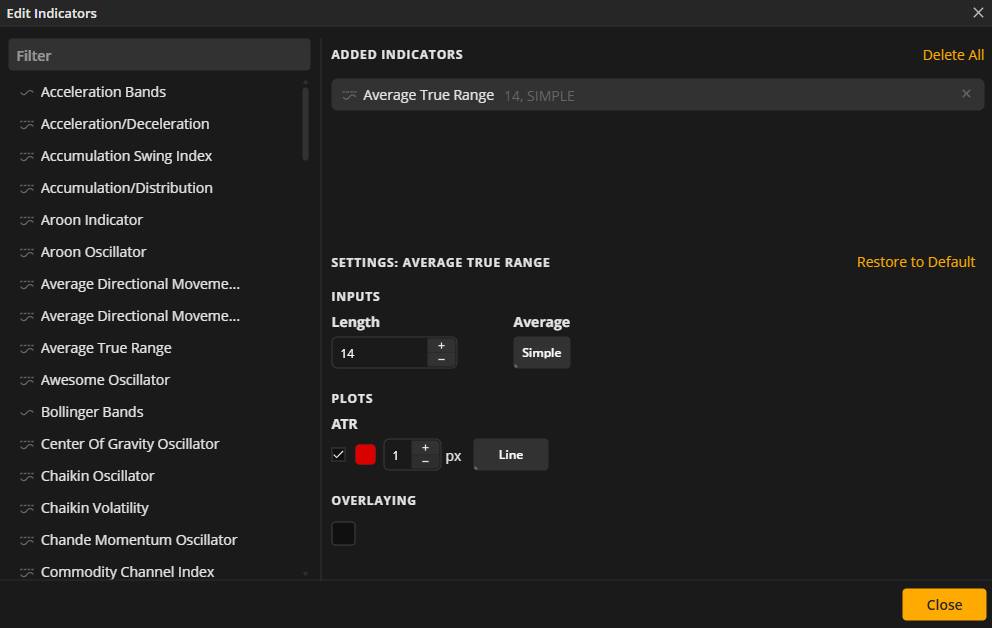
ATR is available in MetroTrader under the Studies (ƒ) menu. Select it from the indicator list, and it will appear as a line in a separate panel below your chart. The default setting is a 14-period Simple ATR, which works well as a starting point for most intraday traders.
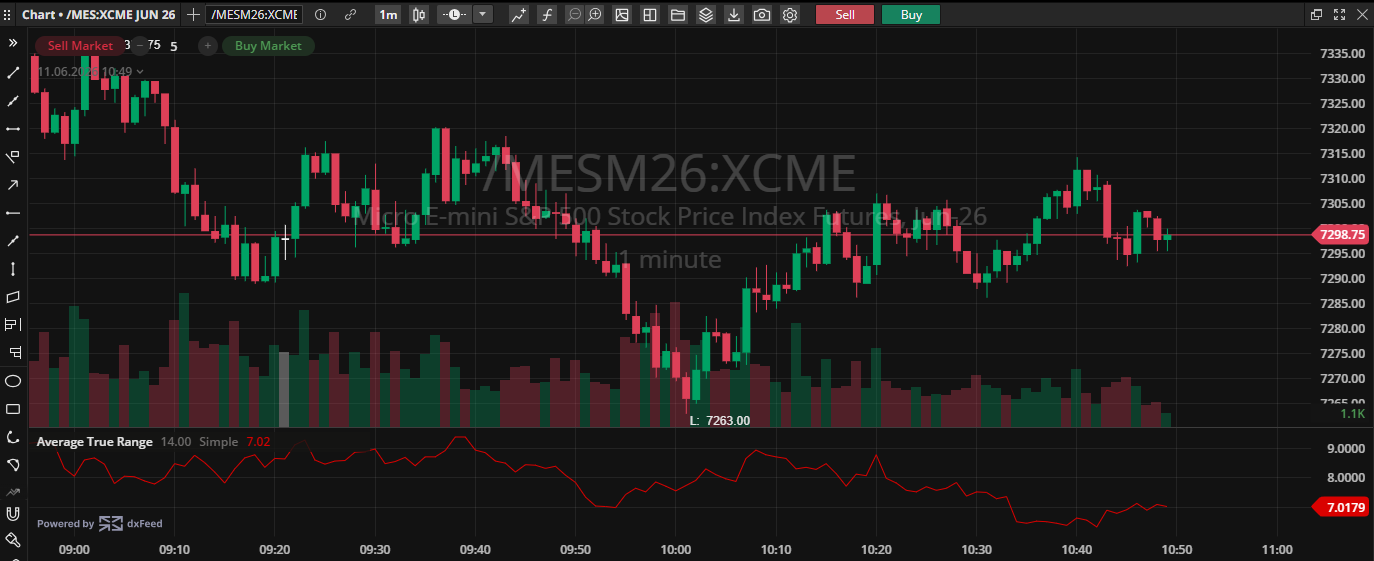
The screenshot above shows ATR applied to a 1-minute MES chart. The ATR line is reading approximately 7.02 ticks, meaning the average candle range over the last 14 bars is just over 7 ticks.
Using ATR to Set Stop Distance
Rather than picking a stop distance based on a round number, traders use ATR as a reference for how much room the market needs to breathe. A stop placed at 0.5x or 1x ATR reflects actual market conditions rather than an arbitrary tick count.
Using the MES example from the chart above:
- ATR reading: approximately 7 ticks on a 1-minute chart
- A 1x ATR stop = 7 ticks
- Risk per MES contract: 7 x $1.25 = $8.75
- With a $50 fixed risk budget: $50 / $8.75 = approximately 5 contracts (round down to 5)
The position sizing formula works exactly the same way. The only difference is that the stop distance input comes from ATR rather than a fixed tick count.
Scaling Back Size in High-Volatility Conditions
When ATR expands, such as around major economic data releases or FOMC announcements, stops must widen to account for normal market noise. Wider stops mean higher risk per contract, which means fewer contracts for the same dollar risk.
This is one of the most useful properties of a consistent sizing approach. It naturally reduces your exposure during turbulent market conditions without requiring a separate judgment call. The math handles it automatically.
Common Position Sizing Mistakes
Even traders with a clear strategy make sizing errors that compound losses unnecessarily. Here are the most common ones:
- Sizing based on available margin. Just because you have enough margin to hold three contracts does not mean you should. Margin availability and appropriate risk are different things entirely.
- Using the same contract count on every trade regardless of stop distance. A 5-tick stop and a 20-tick stop carry very different levels of risk per contract. The number of contracts should change accordingly.
- Ignoring tick value differences between standard and micro contracts. Switching between ES and MES without adjusting contract count will result in 10x the intended risk or 1/10th the intended risk.
- Overriding the formula when confident in a trade. High conviction is not a reliable reason to increase size. It often precedes the trades that cause the most damage.
- Failing to reduce size after a drawdown. If your account drops significantly, your fixed dollar risk or percentage-based risk should produce smaller position sizes automatically. Ignoring this and continuing to trade the same size extends the drawdown.
Position Sizing in Practice: A Full Example
Here is how the complete process looks from start to finish using a realistic smaller account.
Trader profile:
- Account size: $2,000
- Risk approach: fixed $25 per trade
- Market: MES on a 15-minute chart
- Setup: price pulls back to a support level after a trending move, with a planned entry on a bounce
Trade setup:
- Entry: 5,410 on MES
- Stop-loss: 10 ticks below entry at 5,407.50
- Take-profit: 20 ticks above entry at 5,415 (1:2 risk-to-reward)
- Tick value: $1.25 per tick on MES
Sizing calculation:
- Risk per contract: 10 x $1.25 = $12.50
- Contracts: $25 / $12.50 = 2 contracts
This comes out to a clean 2 contracts with no rounding required. If the trade reaches the take-profit at 5,415, the gain is 20 ticks x $1.25 x 2 contracts = $50, a 1:2 risk-to-reward outcome on $25 of actual risk.
Before placing the order, the trader confirms that intraday margin for 2 MES contracts is covered by available account equity. On a $2,000 account with intraday margins starting at roughly $50 per MES contract, this is well within range.
Pro Tip: Always verify that your intended position size fits within your available margin before entering. Size that passes the risk formula but exceeds your margin will result in a rejected order or an automatic liquidation.
Conclusion
Futures position sizing comes down to three inputs: the dollar value of the contract, the amount you are willing to risk per trade, and the distance to your stop-loss. Put those three together, and the math tells you how many contracts to trade.
The formula does not guarantee profitable trades. What it does is to make sure that when trades do not work, the losses stay predictable and manageable. That consistency is what allows traders to stay in the market long enough for their edge to show up over time.
Ready to put it into practice? Open a MetroTrade account and start trading futures with competitive commissions, low intraday margins, and tools built for retail traders.
Frequently Asked Questions
What is futures position sizing?
Futures position sizing is the process of determining how many contracts to trade based on your account size, dollar risk per trade, and the distance to your stop-loss. It ensures that each trade carries a consistent and predetermined level of risk.
How do you calculate position size for futures trading?
Use this formula: Number of Contracts = Max Dollar Risk / (Stop Distance in Ticks x Tick Value). For example, if you are risking $50 and your stop is 10 ticks away on an MES contract with a $1.25 tick value, the calculation is $50 / $12.50 = 4 contracts.
What percentage of my account should I risk per futures trade?
Most retail traders use 1% to 2% of account equity as a maximum risk per trade. On smaller accounts, a fixed dollar amount such as $25 or $50 per trade may be more practical, since the percentage rule can produce numbers that do not align cleanly with contract sizes.
How does tick value affect position sizing?
Tick value directly determines how much risk each contract carries per tick of stop distance. A contract with a $12.50 tick value carries 10 times more risk per tick than one with a $1.25 tick value. Knowing the tick value of the contract you are trading is the starting point for any sizing calculation.
Can I trade futures with a small account using micro contracts?
Yes. Micro contracts such as MES, MNQ, and MGC are one-tenth the size of standard contracts and are designed for traders with smaller accounts. They allow you to apply a consistent risk rule and use realistic stop distances without over-sizing a position.
Should I change my position size based on market volatility?
Yes. When volatility increases, stop distances typically need to widen to account for normal market movement. Wider stops mean higher risk per contract, which means fewer contracts for the same dollar risk. Using a volatility measure like ATR to set stop distance helps sizing adapt to current market conditions.
What is the position sizing formula for futures?
The formula is: Number of Contracts = Max Dollar Risk / (Stop Distance in Ticks x Tick Value). This formula works across any futures contract as long as you know the tick value and your planned stop distance.
What mistakes do traders make when sizing futures positions?
Common mistakes include sizing based on available margin rather than actual risk, using the same number of contracts regardless of stop distance, switching between standard and micro contracts without adjusting size, and increasing size when feeling confident about a trade. Consistent application of a fixed risk rule prevents most of these errors.
The content provided is for informational and educational purposes only and should not be considered trading, investment, tax, or legal advice. Futures trading involves substantial risk and is not suitable for every investor. Past performance is not indicative of future results. You should carefully consider whether trading is appropriate for your financial situation. Always consult with a licensed financial professional before making any trading decisions. MetroTrade is not liable for any losses or damages arising from the use of this content.