

If you’re new to futures trading, you’ve probably used the words “broker” and “platform” to mean the same thing. It’s an easy mistake. Many providers market both under one brand, which makes the line between them hard to see.
But a futures broker and a trading platform are two different things. They serve different functions, carry different responsibilities, and are structured differently. Understanding the distinction helps you evaluate your options more clearly and avoid surprises once you’re trading.
This guide breaks down what each one does, how they interact, and what to look for when you’re comparing providers.
Key Takeaways
- A futures broker is a regulated entity that holds your account and provides market access. A trading platform is the software interface you use to place trades and monitor positions.
- Most retail traders open accounts with an introducing broker (IB), which partners with a Futures Commission Merchant (FCM) to clear trades and hold customer funds.
- Platforms can be proprietary or third-party. Some brokers build their own platforms; others let you connect to licensed third-party software.
- Integrated providers combine brokerage and platform under one roof, which simplifies setup but limits platform flexibility.
- When evaluating your options, assess the broker and platform separately. Regulatory status, clearing arrangement, commission rates, and intraday margins are broker questions. Order types, charting tools, and execution quality are platform questions.
What Is a Futures Broker?
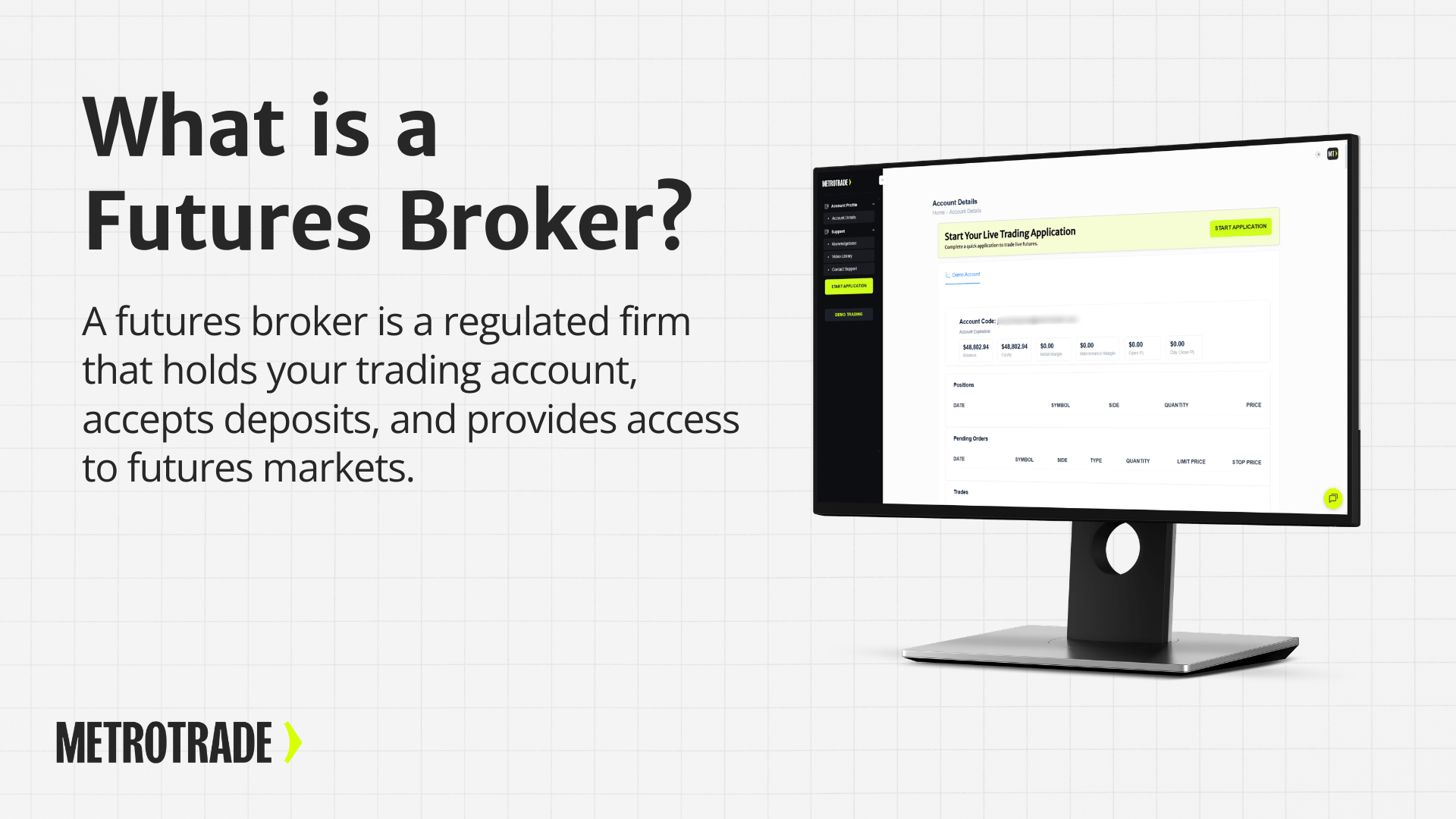
A futures broker is the regulated entity that gives you access to futures markets. It holds your trading account, accepts your deposits, and routes your orders to the exchange.
There are two main types of futures brokers in the U.S., and the distinction matters.
Futures Commission Merchant (FCM)
A Futures Commission Merchant, or FCM, is the entity that directly clears trades and holds customer funds. FCMs are registered with the Commodity Futures Trading Commission (CFTC) and are members of the National Futures Association (NFA). They are subject to strict capital requirements and must segregate customer funds from their own operating capital.
Most retail traders never open an account directly with an FCM. Instead, they work with an introducing broker that has a clearing relationship with an FCM behind the scenes.
Introducing Broker (IB)
An introducing broker, or IB, is a regulated firm that markets brokerage services and onboards customers but does not hold customer funds directly. Instead, the IB routes customer accounts to an FCM, which handles clearing and custody.
IBs are also registered with the CFTC and are NFA members. They carry their own compliance obligations, but the actual handling of funds happens at the FCM level.
Most retail futures brokers you encounter operate as introducing brokers. You may never see the FCM’s name prominently in the marketing, but it’s part of the structure behind your account.
You can verify any broker’s registration status using the NFA’s BASIC lookup tool. This should be a standard step before funding any account. For a more detailed breakdown of how the broker role works, see What is a Futures Broker and Why Do You Need One?
What Is a Futures Trading Platform?
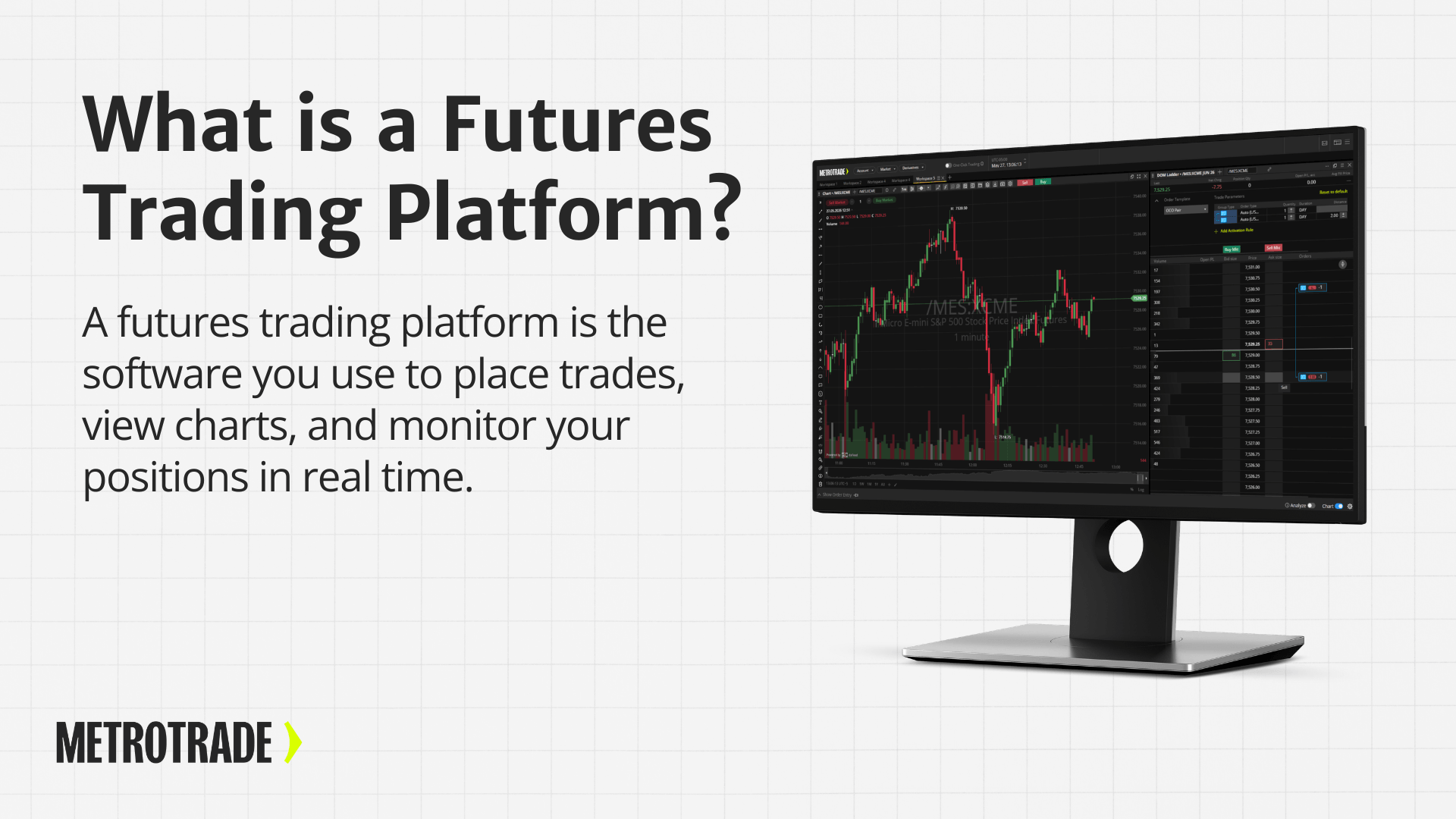
A futures trading platform is the software you use to interact with the market. It displays price data, provides order entry tools, and shows your account status in real time.
A platform is not a regulated entity. It does not hold your money, process your application, or route your orders to the exchange. It is an interface layered on top of the brokerage relationship.
Core Platform Functions
Most futures trading platforms include:
- Order entry: Place market, limit, stop, bracket, and trailing stop orders
- Charting: View price history, apply technical indicators, and draw trendlines
- Depth of Market (DOM): See bid and ask liquidity at each price level and execute directly from the ladder
- Account monitoring: Track open positions, unrealized P&L, margin usage, and account equity in real time
The quality of a platform affects your trading experience significantly. A well-designed platform makes it easier to execute cleanly, manage risk, and stay organized during fast market conditions. But the platform does not change your broker’s regulatory role or how your funds are held.
Proprietary vs. Third-Party Platforms
Platforms fall into two broad categories.
Proprietary platforms are built and maintained by the broker. Your account and your trading interface live within the same ecosystem. You log in once, and everything is connected.
Third-party platforms are software products licensed separately from the brokerage relationship. You open an account with a broker, then connect that account to a third-party platform using login credentials or an API connection. This gives you more flexibility in choosing your interface, but it adds moving parts.
Some third-party platforms charge monthly licensing fees or require separate data subscriptions on top of your brokerage commissions. Factor those costs in when comparing total trading expenses.
How a Broker and a Platform Work Together
When you place a trade, the platform is where you input the order. The broker (and FCM) is what processes it.
Here’s a simplified version of the flow:
- You enter a buy order for one MES (Micro E-mini S&P 500) contract in the platform
- The platform sends that order to the CME exchange with the broker’s and FCM’s credentials
- The order is matched and filled
- The FCM records the position and adjusts your margin and account balance
- The platform reflects the updated position in real time
The platform handles what you see. The FCM and broker handle what happens behind it.
Market data follows a similar path in reverse. The exchange generates price data, which flows through a data feed into the platform’s charting and DOM tools. Some brokers include a basic data feed at no additional cost. Others pass through exchange fees or require upgraded subscriptions for more detailed order book data.
Integrated vs. Separate: How the Models Compare
The relationship between broker and platform varies by provider. There are two common models.
The Separate Model
In the separate model, the broker, platform, and data feed are distinct products. You open a brokerage account with one provider, then independently select and configure a platform that connects to it.
This structure offers more flexibility. If you want to switch platforms without changing brokers, or vice versa, you can do so.
The tradeoffs are real, though. You may be managing multiple logins, support relationships, and fee structures. If something breaks during a trade, it’s not always immediately clear whether the issue is on the broker side or the platform side.
The Integrated Model
In the integrated model, the broker maintains its own platform. Your account, your order entry tools, your charts, and your funding are all part of one connected system.
This approach simplifies the experience considerably. One login, one support team, and one pricing structure covering both brokerage and platform access. There are fewer points of friction during onboarding and fewer places for something to go wrong.
For traders who value a clean, streamlined setup, the integrated model typically wins on simplicity.
MetroTrade operates this way. MetroTrader is available via web and mobile, and the brokerage account is built into the same ecosystem. There’s no separate software to install or license. You can learn more about the platform at MetroTrader: A Free Futures Trading Platform for Traders.
What a Broker Is Responsible For
When you evaluate a futures broker, you’re assessing a regulated business with specific legal and operational obligations. Here’s what falls under the broker’s responsibility:
- Account opening and identity verification: Brokers are required to verify your identity and assess your trading experience before approving an account
- Regulatory compliance: FCMs and IBs must maintain registration with the CFTC and NFA membership in good standing
- Fund custody: At the FCM level, customer funds must be held in segregated accounts separate from the firm’s operating capital
- Margin enforcement: Brokers monitor account margin in real time and may liquidate positions if margin falls below required levels
- Commission and fee structure: The broker sets per-side commissions and passes through any exchange or NFA fees
These are the factors that determine the safety, cost, and reliability of your brokerage relationship. They are separate from anything the platform provides.
What a Platform Is Responsible For
The platform sits on top of the brokerage relationship and is responsible for the tools and interface you use while trading. Key platform responsibilities include:
- Displaying market data accurately in real time or with minimal delay
- Providing reliable order entry tools, including advanced order types like bracket orders and trailing stops
- Charting and technical analysis with a range of indicators and drawing tools
- DOM functionality for traders who use order flow as part of their strategy
- Position and account monitoring during the trading session
- Platform stability during high-volume periods like the open of the U.S. session or major economic data releases
- Order routing: the platform may route your orders directly to the exchange, or it may utilize a 3rd party (like CQG or Rithmic), who is responsible for execution quality at the infrastructure level
- Mobile access for traders who monitor or manage positions away from a desktop
Platform quality directly affects your trading experience. Slow execution, unreliable data, or a poorly designed order entry panel can create real problems in fast markets like the ES or NQ. That said, platform issues are distinct from broker issues. If your account is with a well-regulated broker, the integrity of your funds is not affected by a platform glitch.
What to Look For When Evaluating Each
Separating your evaluation into broker questions and platform questions makes the process cleaner.
Evaluating a Futures Broker
- Regulatory status: Confirm CFTC registration and NFA membership using the NFA BASIC tool
- Clearing arrangement: Understand who the FCM is and how your funds are held
- Commission structure: Know the per-side rate for the contracts you plan to trade. For micro contracts like MES or MNQ, even small differences in per-side commissions add up quickly for active traders
- Intraday margin requirements: Brokers set their own intraday margins, which can differ significantly from exchange overnight margins. Lower intraday margins reduce the capital needed to hold a position during the session. Compare rates across brokers for the specific contracts you’re trading.
- Funding process: Understand how deposits and withdrawals work and how long account approval takes
- Customer support: Test responsiveness before you need it
For a deeper look at what to consider when looking for a futures broker, read How to Choose the Best Futures Broker in 2026.
Evaluating a Futures Platform
- Order types: Confirm support for bracket orders, trailing stops, and limit orders at minimum
- Charting quality: Look at the indicator library, chart types, and drawing tools available
- DOM availability: Essential for active intraday traders and scalpers
- Mobile access: Relevant if you need to manage positions away from a desktop
- Platform fees: Determine whether there are monthly licensing costs or separate data subscription fees
- Demo access: A simulated trading environment lets you test the platform before funding a live account
Common Mistakes Traders Make When Choosing
A few patterns come up repeatedly when traders evaluate futures providers.
- Treating broker and platform as the same thing. This leads to gaps in evaluation. You might assess the platform carefully and completely overlook the broker’s commission structure or clearing arrangement.
- Choosing a platform first. Some traders fall in love with a particular interface and then open an account with whatever broker supports it, without evaluating that broker independently.
- Not verifying NFA registration. It takes about 30 seconds on the NFA BASIC tool and should be non-negotiable before funding any account.
- Overlooking the FCM relationship. If you’re opening an account with an IB, know who the clearing FCM is and confirm they are separately registered.
- Ignoring intraday margin rates. Two brokers can offer the same platform experience but require very different amounts of capital to hold a single MES or NQ position intraday. This affects how many contracts you can trade and how your account handles drawdowns.
- Forgetting platform fees in the cost comparison. A broker with lower commissions may look cheaper until you add a monthly platform licensing fee or exchange data subscription. Calculate total cost per trade, not just the headline commission rate. Compare fees across futures brokers
Conclusion
A futures broker and a trading platform are two separate things that work together. The broker is the regulated entity that holds your account and routes your orders. The platform is the interface you use to trade. Some providers keep these separate. Others integrate them into a single experience.
If you want to see how an integrated broker-platform works, open an account with MetroTrade today.
Frequently Asked Questions
What is the difference between a futures broker and a trading platform?
A futures broker is a regulated entity that holds your trading account, accepts deposits, and routes orders to the exchange. A trading platform is the software interface used to place trades, view charts, and monitor positions. They serve different functions and can come from the same provider or different ones.
Do I need both a broker and a platform to trade futures?
Yes. You need a regulated brokerage account to access futures markets, and you need a platform to enter and manage trades. Some providers offer both in one integrated package. Others require you to connect a brokerage account to a separately licensed platform.
What is an introducing broker in futures trading?
An introducing broker (IB) is a regulated firm that markets brokerage services and onboards customers but does not hold customer funds directly. IBs partner with a Futures Commission Merchant (FCM) that handles clearing and custody. Most retail futures brokers operate as introducing brokers.
What is an FCM in futures trading?
A Futures Commission Merchant (FCM) is the entity that clears trades and holds customer funds directly. FCMs are registered with the CFTC and must keep customer funds in segregated accounts. If you open an account with an introducing broker, an FCM handles the clearing side behind the scenes.
Can I use any platform with any futures broker?
Not always. Some brokers only support their own proprietary platform. Others allow you to connect third-party platforms through an API or login integration. If platform flexibility matters to you, confirm compatibility before opening an account.
What should I look for in a futures trading platform?
Key factors include order type support (especially bracket orders and trailing stops), charting tools and indicator library, DOM functionality, mobile access, platform stability, and whether there are any platform fees or data subscription costs on top of commissions.
How do I verify a futures broker is regulated?
Visit the NFA BASIC lookup tool and search by firm name or NFA ID. Confirm the broker is registered with the CFTC and holds active NFA membership. This should be a standard step before funding any futures account.
The content provided is for informational and educational purposes only and should not be considered trading, investment, tax, or legal advice. Futures trading involves substantial risk and is not suitable for every investor. Past performance is not indicative of future results. You should carefully consider whether trading is appropriate for your financial situation. Always consult with a licensed financial professional before making any trading decisions. MetroTrade is not liable for any losses or damages arising from the use of this content.