

Futures markets move in both directions. When traders expect a market to fall, one approach is to short a futures contract outright. Another is to buy a put option on that futures contract, which gives you defined downside exposure without the open-ended risk of holding a short futures position.
A put option on a futures contract gives the buyer the right, but not the obligation, to sell a futures contract at a specific price before the option expires. You pay a premium upfront, and that premium is the most you can lose on the trade.
This guide covers how put options on futures work, what the key terms mean, how pricing works, and what to think about before trading. MetroTrade currently offers long calls and long puts on CME-listed contracts, including ES, NQ, CL, and GC.
Key Takeaways
- A put option on a futures contract gives you the right, but not the obligation, to sell a futures contract at a specific strike price before expiration. You pay a premium upfront to acquire that right.
- The premium you pay is the most you can lose on a long put position. Unlike shorting a futures contract outright, there is no margin call risk on the option itself.
- Buying a put lets you participate in downside price movement in a futures market while limiting your loss to the cost of the option. But the option can still expire worthless if the market does not move far enough in your direction.
- Put options on futures differ from shorting a futures contract in one important way: your maximum loss is defined from the moment you enter. A short futures position has theoretically unlimited loss potential if the market rallies against you.
- Time decay and implied volatility work against put buyers. Even if your directional view is correct, poor timing or a drop in volatility after entry can reduce the value of your option.
What Is a Put Option on a Futures Contract?
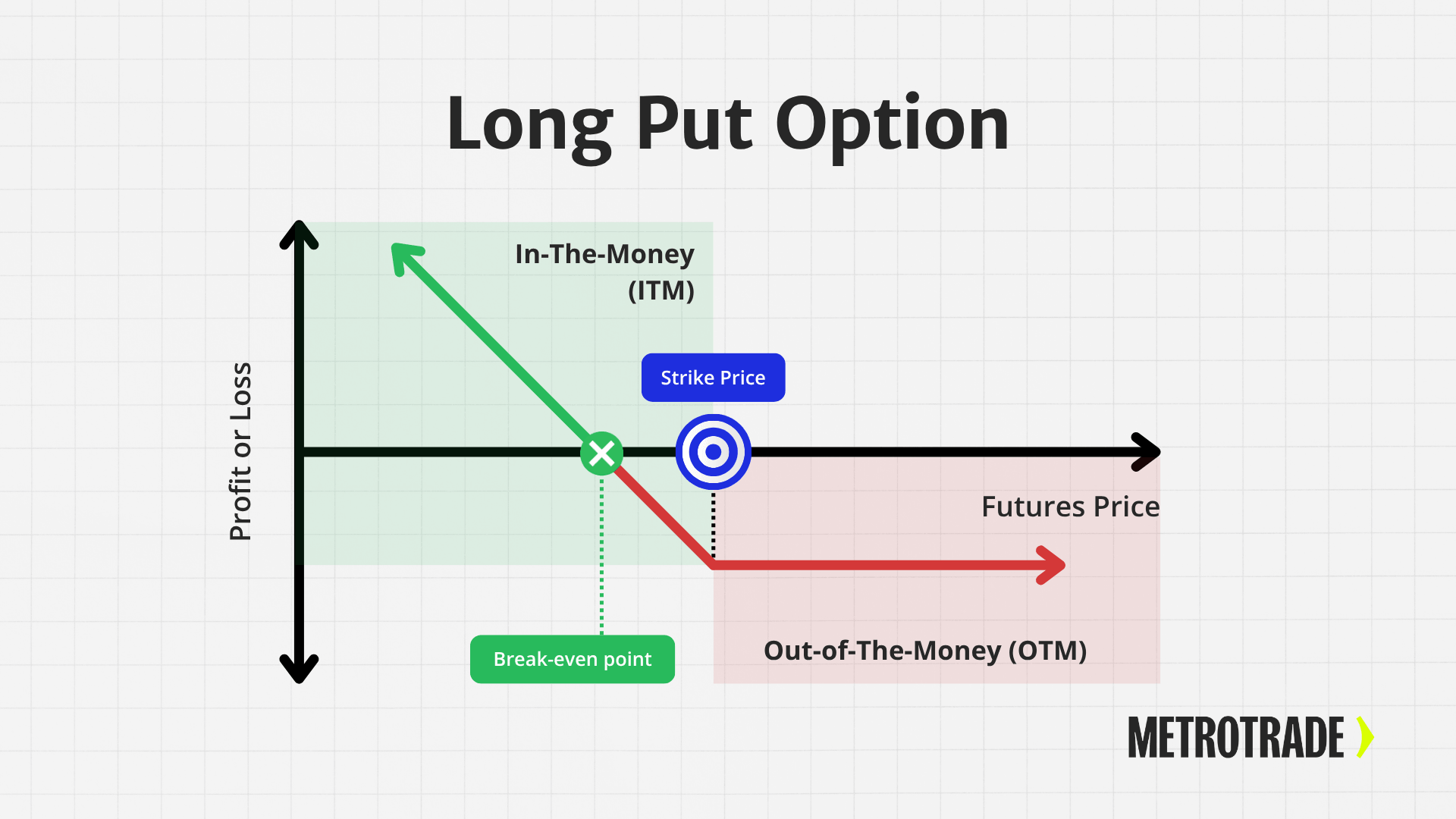
A put option gives the buyer the right, but not the obligation, to sell a specific futures contract at a predetermined price, known as the strike price, on or before the option’s expiration date.
When you buy a put option on a futures contract, you are not shorting the futures contract itself. You are buying the right to enter a short futures position at the strike price. If the futures price falls below the strike before expiration, the option gains value. If it does not, the option can expire worthless.
The buyer pays a premium to the seller in exchange for this right. That premium is the maximum amount the buyer can lose on the trade.
How Put Options on Futures Differ from Stock Options
The mechanics of a put option work similarly whether the underlying is a stock or a futures contract. But there are meaningful differences worth understanding.
With stock options, the underlying is shares of a company. With futures options, the underlying is a futures contract on an index, commodity, currency, or interest rate product.
Settlement also works differently. Many futures options settle into a futures position rather than cash. If a put on ES futures expires in the money, the buyer may be assigned a short ES futures position. This is important to understand before holding options until expiration.
Margin treatment differs as well. When you buy a put option, you pay the premium upfront. There is no ongoing margin requirement for the long option position itself, and you cannot receive a margin call on it. This is structurally different from holding a short futures contract, which requires margin and generates daily mark-to-market gains or losses.
Key Terms Every Beginner Should Know
Before going further, it helps to define the terms that come up repeatedly when discussing put options on futures. Note that the in-the-money and out-of-the-money logic for puts is the mirror image of calls.
- Premium: The price you pay to buy the put option. This is your total cost and maximum risk on the trade.
- Strike price: The price at which you have the right to sell the underlying futures contract.
- Expiration date: The date on which the option expires. After this point, the option has no value if it has not been exercised or sold.
- In-the-money (ITM): For a put, this means the futures price is below the strike price. The option has intrinsic value.
- Out-of-the-money (OTM): The futures price is above the strike price. The option has no intrinsic value, only time value.
- At-the-money (ATM): The futures price is approximately equal to the strike price.
- Intrinsic value: The real, immediate value of the option. For a put, it equals the difference between the strike price and the current futures price when the option is in the money.
- Time value: The portion of the premium that reflects the remaining time before expiration and the possibility that the option moves further in your favor. All options carry time value until expiration.
Understanding these terms is foundational. Every decision you make as a put buyer, including which strike to choose and how long to hold, connects back to these concepts.
How Buying a Put Option on Futures Works
The mechanics are straightforward once you work through an example.
You identify a futures market you expect to move lower. You purchase a put option on that futures contract, selecting a strike price and expiration date. You pay the premium. From that point, one of three things happens:
- The futures price falls below your strike before expiration. Your option is in the money. It has gained value, and you can sell it at a profit or, in some cases, exercise it to receive a short futures position.
- The futures price stays flat or moves slightly. Depending on how far OTM you were and how much time has passed, the option may have lost value. If it expires above your strike, it expires worthless.
- The futures price rises. Your put loses value. If it expires above the strike, you lose the premium you paid. Nothing more.
In all three scenarios, your maximum loss is the premium you paid at entry.
A Simple Example Using ES Options
Suppose ES futures (the E-mini S&P 500) are trading at 5,500. You believe the market will move lower over the next few weeks. You buy one put option on ES with a strike price of 5,450 and pay a premium of $500.
Here is how three outcomes might look at expiration:
- ES falls to 5,350. Your put is 100 points in the money. Each ES point is worth $50, so the intrinsic value is $5,000. After subtracting the $500 premium you paid, your net gain is $4,500.
- ES finishes at 5,480. Your put is still out-of-the-money at expiration. It expires worthless. You lose the $500 premium.
- ES rallies to 5,600. Your put expires worthless. You lose the $500 premium. Your loss does not increase beyond that, regardless of how far ES rallied.
This is a hypothetical illustration. Actual outcomes depend on the specific option, pricing at the time, and how you manage the position.
Why Traders Buy Put Options on Futures
There are several structural reasons traders choose to buy puts on futures rather than shorting the futures contract outright.
Defined risk. The most significant feature of buying a put is that your loss is capped at the premium. If you short an ES futures contract and the market rallies sharply against you, your loss grows with every point the market rises. With a long put, the worst case is losing what you paid.
Directional exposure with a known cost. A long put lets you participate in a downside move in a futures market while knowing exactly how much you are risking from the moment you enter.
Positioning around events. Some traders use put options ahead of scheduled events like Fed meetings, CPI releases, or major economic reports. A long put gives directional exposure to a potential downside move without the open-ended risk of holding a short futures position into a binary event.
Hedging an existing long futures position. Traders who hold long futures contracts sometimes buy puts as a form of protection. If the market falls sharply, the put gains value and offsets some or all of the loss on the futures position. This is one of the more common structural uses of long puts in futures markets.
None of these points suggest that buying puts is a low-risk or easy approach to trading. The option can and often does expire worthless. These are structural characteristics, not performance claims.
How Put Options on Futures Are Priced
Option pricing can get complex quickly, but for beginners, the key is understanding the three main drivers of premium.
Intrinsic value is straightforward. If a put is in the money, it has intrinsic value equal to the difference between the strike price and the current futures price. An OTM put has zero intrinsic value.
Time value is the remaining premium above intrinsic value. It reflects the probability that the option moves further in the money before expiration. More time remaining means more time value. As expiration approaches, time value erodes. This erosion is called theta, or time decay.
Implied volatility (IV) is the market’s expectation of how much the underlying futures contract will move. Higher implied volatility means higher premiums, because there is a greater perceived chance of a large move in either direction. Lower IV means cheaper premiums.
What This Means for Put Buyers
As a buyer of a put option, time decay works against you every day you hold the position. If the market stays flat, your option loses value simply because time is passing.
Implied volatility is also a factor after entry. Put options are often priced with elevated IV ahead of major news events, when fear and uncertainty are high. Once the event passes, IV can drop sharply, which reduces the option’s value even if the market moves in your direction. This is called IV crush, and it is one of the most common surprises for traders new to options.
These dynamics are why strike selection, expiration timing, and entry timing all matter for put buyers, not just the directional view.
Choosing a Strike Price and Expiration
Two of the most important decisions when buying a put are the strike price and the expiration date. Both directly affect cost and the conditions under which the trade becomes profitable.
Strike price considerations:
- OTM puts cost less but requires a larger downside move in the underlying futures to become profitable at expiration. They have higher leverage in percentage terms but a lower probability of expiring in the money.
- ITM puts cost more because they already have intrinsic value. They behave more like the short futures contract and are less sensitive to time decay as a percentage of premium.
- ATM puts sit between the two. They carry the most time value as a proportion of total premium and are sensitive to both direction and time decay.
Expiration considerations:
- More time to expiration means a higher premium but more runway for the trade to develop.
- Shorter expirations are cheaper but expose you to faster time decay. A short-dated OTM put needs the market to move quickly and significantly in your direction.
An example using NQ options:
Suppose NQ futures (the E-mini Nasdaq-100) are trading at 19,500. You are considering a put with a 19,200 strike expiring in 30 days versus one expiring in 60 days. The 60-day put will carry more premium because of the additional time value, but it gives the trade more room to develop. The 30-day put is cheaper but will decay faster if NQ does not move lower quickly toward the strike.
The right choice depends on your trade rationale, how much premium you are willing to spend, and how much time you think the move needs to play out.
Risks of Buying Put Options on Futures
Buying a put limits your downside to the premium paid, but that does not make the risk small. Here are the main risks to understand before trading.
You can lose 100% of the premium. If the option expires worthless, the entire premium is lost. This is the defined maximum loss, but it is still a complete loss on the position.
Time decay erodes value continuously. Every day that passes without a sufficient downward move in the underlying reduces the option’s value. Holding a put through an extended sideways or rising market is costly.
Implied volatility can work against you. If you buy when IV is elevated and it drops after entry, the premium falls even if the underlying moves in your direction. You can be right about direction and still lose money if IV compresses enough after the event you were trading.
Strike and expiration selection matter significantly. Choosing an expiration that is too short or a strike that is too far out of the money can result in a worthless option, even when the underlying eventually moves lower.
Your directional view can be correct, but your timing is wrong. Options on futures have defined expiration dates. A move that happens after expiration does not help you. Unlike holding a short futures contract indefinitely, a long put has a hard deadline.
Put Options on Futures vs. Shorting a Futures Contract
These are two different tools for taking a bearish position in a futures market. Neither is inherently better. They serve different purposes and carry different risk profiles.
|
Short Futures Contract |
Long Put Option |
|
|
Upfront cost |
Margin deposit required |
Premium paid |
|
Maximum loss |
Unlimited (market can rally indefinitely) |
Limited to premium paid |
|
Profit potential |
Unlimited to the downside |
Unlimited below strike, minus premium |
|
Effect of time |
No time decay |
Time decay erodes value daily |
|
Margin calls |
Yes, if the position moves against you |
No margin call on the long option |
|
Volatility impact |
Indirect |
Direct through IV pricing |
A short futures contract gives you full, immediate exposure to price movement in both directions. You need margin to hold it, and adverse moves require additional capital or position closure.
A long put gives you capped upside loss at the cost of a premium, plus the ongoing drag of time decay. It is not a free way to take a bearish position. The premium is a real cost, and losing it entirely is a real outcome.
The choice between them depends on your risk tolerance, trade rationale, and how much you are willing to spend for the defined-risk structure a long put provides.
What to Consider Before Buying a Put on a Futures Contract
Put options on futures add a layer of complexity beyond straightforward futures trading. Before entering a long put position, it is worth working through a few honest questions.
- Do you understand how the underlying futures contract works? Options pricing is tied to the behavior of the underlying. If you are not familiar with how ES or NQ moves, the options layer adds difficulty.
- Do you understand options pricing basics? Specifically, do you know how time decay and implied volatility will affect your position between entry and expiration?
- Are you comfortable with the possibility of losing the entire premium? A long put has a defined maximum loss, but that maximum loss is 100% of what you paid.
- Have you thought through your exit plan? Will you hold to expiration, or do you have a plan to close the position early if it moves in your favor or against you?
MetroTrade offers options on futures on CME-listed contracts, including ES, NQ, CL, and GC, through the MetroTrader platform.
Conclusion
Buying a put option on a futures contract gives you the right to go short a futures contract at a set price, with your maximum loss defined by the premium you pay upfront. That defined-risk structure is one of the main reasons traders use long puts instead of, or alongside, outright short futures positions.
But a long put is not necessarily a simple trade. Time decay works against you every day. Implied volatility affects pricing in ways that can catch new traders off guard. And the option can expire worthless even when your directional view was largely correct.
Understanding the mechanics, the pricing dynamics, and the risks before entering any options trade is essential. MetroTrade offers long calls and long puts on CME-listed futures contracts, including ES, NQ, CL, and GC. If you’re ready to start trading options on futures, open an account today and request access.
Frequently Asked Questions
What is a put option on a futures contract?
A put option on a futures contract gives the buyer the right, but not the obligation, to sell a specific futures contract at a predetermined strike price on or before the option’s expiration date. The buyer pays a premium upfront to acquire this right.
How much can you lose by buying a put option on futures?
The maximum loss when buying a put option is limited to the premium you paid. If the option expires worthless, you lose that premium entirely, but your loss cannot exceed it.
How are put options on futures different from stock options?
The primary difference is the underlying asset. Stock options give you the right to buy or sell shares. Futures options give you the right to enter a futures contract position. Futures options may also settle into a futures position rather than cash, and the margin structure differs from stock options.
What does the premium mean when buying a futures put option?
The premium is the price you pay to purchase the put option. It represents your total cost and maximum risk on the trade. It is made up of intrinsic value (if the option is in the money) and time value (the additional amount reflecting time remaining and implied volatility).
Can beginners trade put options on futures?
Put options on futures are available to retail traders, but they involve additional complexity compared to trading futures outright. Beginners should understand how futures contracts work, how options are priced, and how time decay and implied volatility affect a long put position before trading.
What happens when a put option on futures expires?
If the put expires in the money, the buyer may receive a short futures position at the strike price or a cash settlement depending on the contract. If the put expires out-of-the-money or at-the-money, it expires worthless, and the buyer loses the premium paid.
What contracts can you trade options on at MetroTrade?
MetroTrade currently offers long calls and long puts on CME-listed futures contracts, including the E-mini S&P 500 (ES), Nasdaq-100 (NQ), Crude Oil (CL), and Gold (GC).
The content provided is for informational and educational purposes only and should not be considered trading, investment, tax, or legal advice. Futures trading involves substantial risk and is not suitable for every investor. Past performance is not indicative of future results. You should carefully consider whether trading is appropriate for your financial situation. Always consult with a licensed financial professional before making any trading decisions. MetroTrade is not liable for any losses or damages arising from the use of this content.
Transactions in options carry a high degree of risk. Purchasers and sellers of options should familiarize themselves with the type of option (i.e. put or call) which they contemplate trading and the associated risks. You should calculate the extent to which the value of the options must increase for your position to become profitable, taking into account the premium and all transaction costs. The purchaser of options may offset or exercise the options or allow the options to expire. The exercise of an option results either in a cash settlement or in the purchaser acquiring or delivering the underlying interest. If the option is on a future, the purchaser will acquire a futures position with associated liabilities for margin (see the section on Futures above). If the purchased options expire worthless, you will suffer a total loss of your investment, which will consist of the option premium plus transaction costs. If you are contemplating purchasing deep out-of-the-money options, you should be aware that the chance of such options becoming profitable ordinarily is remote. Selling (‘writing’ or ‘granting’) an option generally entails considerably greater risk than purchasing options.
Although the premium received by the seller is fixed, the seller may sustain a loss well in excess of that amount. The seller will be liable for an additional margin to maintain the position if the market moves unfavorably. The seller will also be exposed to the risk of the purchaser exercising the option, and the seller will be obligated to either settle the option in cash or to acquire or deliver the underlying interest. If the option is on a future, the seller will acquire a position in a future with associated liabilities for margin (see the section on Futures above). If the position is ‘covered’ by the seller holding a corresponding position in the underlying interest or a future or another option, the risk may be reduced. If the option is not covered, the risk of loss can be unlimited. Certain exchanges in some jurisdictions permit deferred payment of the option premium, exposing the purchaser to liability for margin payments not exceeding the amount of the premium. The purchaser is still subject to the risk of losing the premium and transaction costs. When the option is exercised or expires, the purchaser is responsible for any unpaid premiums outstanding at that time.