

Most traders who buy their first option on futures understand the basic idea. Pay a premium, get the right to enter a futures contract at a set price, and limit your downside to what you paid. What takes longer to learn is how strike price, expiration, and premium interact to shape the actual cost and risk of every trade.
This guide takes a closer look at those three variables. It assumes you already have a working understanding of how options on futures work. If you’re starting from scratch, What Are Options on Futures? covers the foundational mechanics. This article focuses on the decision-making layer: what each variable controls, how it behaves over the life of the trade, and how to think about all three together before placing a position.
Key Takeaways
- The strike price you choose sets your break-even and determines how much the market needs to move before the trade becomes profitable. Selecting a strike that looks cheap without calculating break-even is one of the most common errors new options traders make.
- Expiration controls how much time the trade has to work, and the time remaining is a direct input into what you pay in premium. A longer expiration costs more but gives the market room to develop; a short expiration is cheaper but leaves little margin for error.
- Premium is made up of two components that behave very differently: intrinsic value and time value. Intrinsic value reflects how far in the money the option already is; time value reflects what you pay for the possibility of future movement.
- Time decay accelerates sharply in the final weeks before expiration, working against buyers regardless of what the underlying market does. A trade that is correct in direction but too slow in timing can still result in a full loss of premium.
- Strike price and expiration should be selected together, not independently, based on a specific view about the magnitude and timing of an expected move. The resulting premium is the outcome of those two choices, not a starting point.
Strike Price: What It Controls and How to Choose It
What the Strike Price Actually Determines
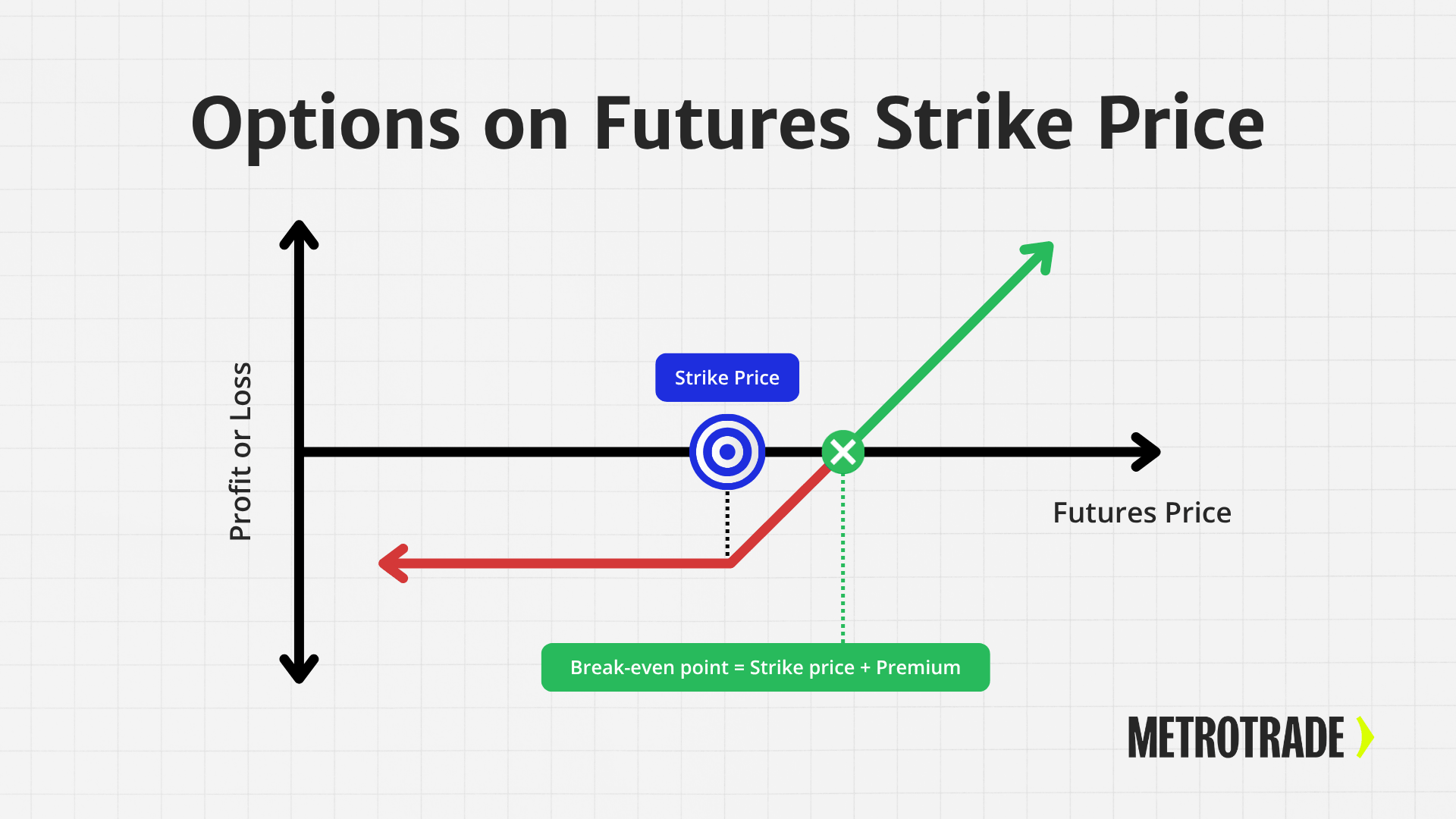
The strike price is the price at which you have the right to enter the underlying futures contract if you exercise the option. But in practice, the strike is less about exercise rights and more about defining the math of your trade before you place it.
Three things flow directly from strike selection:
- Your break-even price: For a call, this is the strike plus the premium paid. For a put, it is the strike minus the premium paid. The market must reach this level for the trade to be profitable at expiration.
- Your premium cost: Strikes closer to the current futures price cost more. Strikes further away cost less. The difference is not arbitrary; it reflects probability.
- How much movement is required: A strike that is far from the current price requires a larger, faster move to pay off. A strike near the current price has a lower bar.
Consider an example. E-mini S&P 500 futures (ES) are trading at 5,350. A trader buys a call option with a strike of 5,400. The premium is 18.00 points. One ES point is worth $50, so the total cost of the option is $900.
The break-even is 5,418 (strike of 5,400 plus 18 points of premium). ES must be above 5,418 at expiration for this trade to generate a profit. If ES closes at 5,410 at expiration, the option is in the money, but the trader still loses money, because the gain in intrinsic value ($500) does not cover the premium paid ($900).
The strike does not just sit in the background. It defines the entire structure of the trade.
The CME Group breaks down strike price mechanics in this short video:
ITM, ATM, and OTM: The Practical Trade-Offs
In-the-money (ITM), at-the-money (ATM), and out-of-the-money (OTM) are terms for describing how a strike price relates to the current futures price. Each carries a distinct set of trade-offs beyond the basic definition.
In-the-money options:
- Already have intrinsic value built into the premium
- Cost more than ATM or OTM options
- Move more like the underlying futures contract (higher delta)
- Have a lower bar to profitability because you are not starting from zero intrinsic value
- Make sense when a trader wants behavior similar to a futures position but with defined downside
At-the-money options:
- Strike is at or very near the current futures price
- Carry the highest time value component relative to the intrinsic value
- Move about half a point for every one-point move in the underlying (roughly 0.50 delta)
- Offer clean directional participation without requiring a strong view on magnitude
- Are the most commonly traded strikes for outright directional plays
Out-of-the-money options:
- Have no intrinsic value; the entire premium is time value
- Are cheaper in dollar terms but require a larger price move before the trade becomes profitable
- Have a lower probability of finishing in-the-money by expiration
- Are frequently misread as “cheap” by new traders when measured in premium cost alone
- The real question is not whether the premium is low in dollars; it is whether the required move to reach break-even is realistic
OTM options often look attractive because the absolute dollar cost is small. But if a Gold futures (GC) option costs $8 per ounce and the strike is $40 away from the current futures price, the underlying needs to move more than $48 per ounce just to break even. That context matters more than the headline cost.
Selecting a Strike Based on a Market View
The right way to choose a strike is to start with a view, then find the strike that fits it. The view has two components: direction and magnitude.
Here is a worked comparison using Gold futures (GC), currently trading at 3,500.
Trader A expects a $50 move higher over the next month. They buy an ATM call with a strike of 3,500. The premium is $22 per ounce. Since one GC contract covers 100 troy ounces, the total cost is $2,200.
- Break-even: 3,522
- Required move to profit: $22 per ounce
- If GC finishes at 3,550 at expiration: intrinsic value is $50, minus $22 premium, for a net gain of $28 per ounce ($2,800 on the contract)
Trader B expects the same directional move but wants to pay less upfront. They buy an OTM call with a strike of 3,550. The premium is $8 per ounce ($800 total).
- Break-even: 3,558
- Required move to profit: $58 per ounce
- If GC finishes at 3,550 at expiration: the option expires exactly at-the-money, with no intrinsic value. Trader B loses the full $800.
Both traders were correct that GC would move $50 higher. Only Trader A profited. The difference was strike selection.
Pro tip: Before placing any options trade, calculate your break-even price in the price terms of the underlying contract. Know exactly how far the market needs to move before your premium is covered.
Expiration: The Clock Running Against the Buyer
How Expiration Is Structured for Options on Futures
Options on futures have their own expiration schedule, which is typically separate from the expiration of the underlying futures contract. In most cases, options expire before the futures contract they are tied to, so the underlying futures still have time remaining after the option expires.
CME-listed options generally come in several expiration cycles:
- Quarterly expirations: Align with the standard futures contract cycle (March, June, September, December)
- Serial expirations: Monthly expirations that fall between the quarterly dates, available on many major contracts
- Weekly expirations: Available on some high-volume products like ES and NQ, expiring on specific days of the week
This structure gives traders meaningful flexibility. A trader who expects a move over the next three weeks does not have to buy a full quarterly option. They can select a serial or weekly expiration that fits the timeframe of their thesis, often at a lower premium cost.
At expiration, the outcomes are straightforward:
- ITM options can be exercised into a futures position at the strike price. A call gives you a long futures position; a put gives you a short.
- OTM options expire worthless. The premium paid is lost.
- Most retail traders close positions before expiration to avoid taking delivery of a futures position they may not want to manage.
The CME Group walks through expiration date mechanics in this short video:
Time Value and the Decay Curve
Every option’s premium contains a time value component. That component starts large and shrinks to zero by expiration. This erosion is called time decay, and the rate of decay is measured by a Greek letter called theta.
What makes time decay significant is that it is not linear. An option does not lose an equal amount of time value each day. The decay curve looks roughly like this:
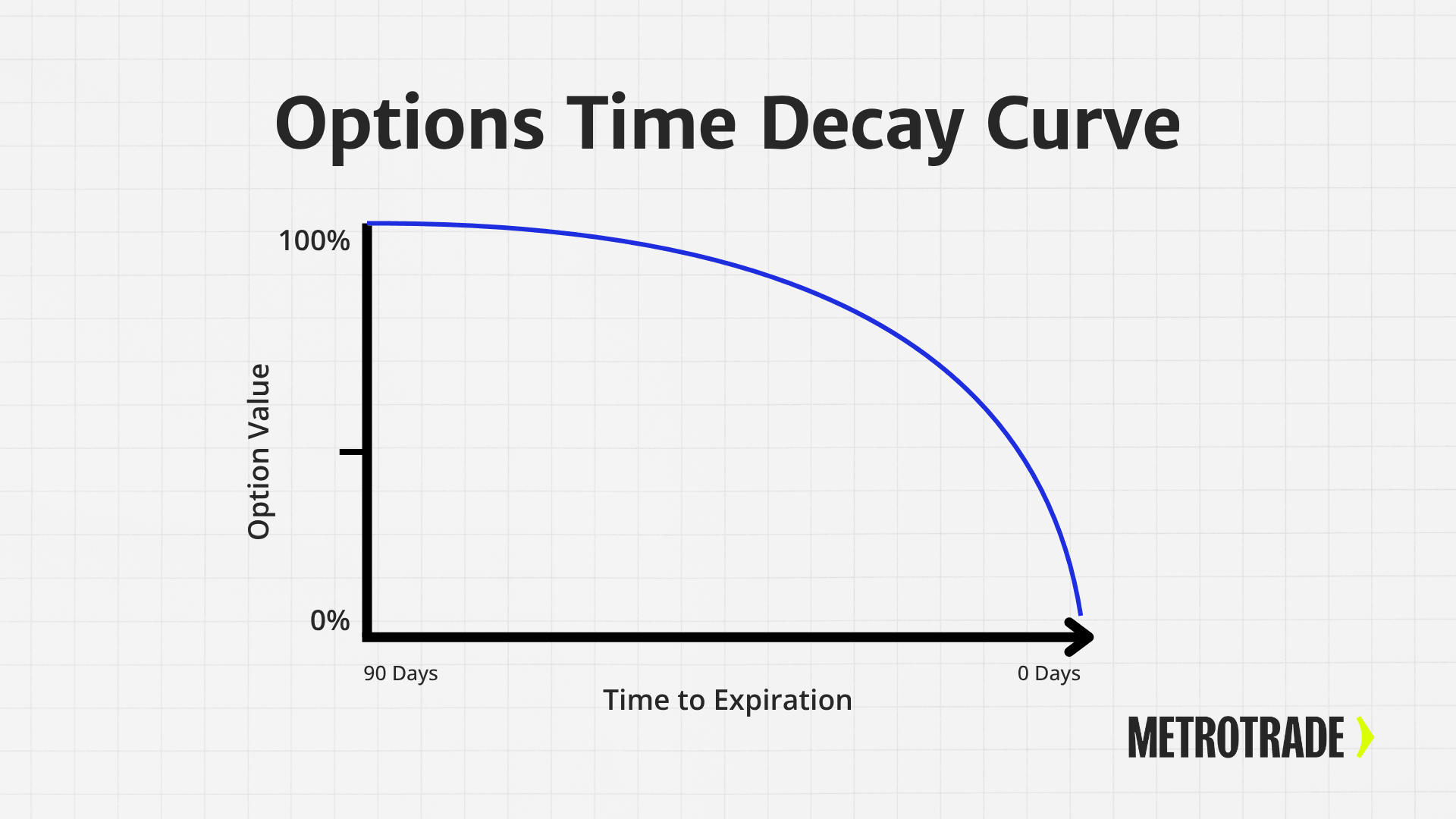
- 90 days to expiration: Time decay is relatively slow. The option loses a modest amount of time value each day.
- 30 days to expiration: Decay begins to accelerate. Each passing day removes more value than the day before.
- Final 2 weeks: Decay is at its fastest. An option that still has significant time value two weeks out can lose a large portion of it quickly, even if the underlying barely moves.
This has a direct consequence for buyers: the longer you hold an options position without the underlying moving in your direction, the more you are paying for time that is no longer working for you.
Consider two traders who buy Crude Oil futures (CL) call options at the same strike. Trader A buys 45 days before expiration. Trader B buys the same strike 10 days before expiration.
- Trader A pays a higher premium, but the time value component is spread across 45 days. They have room for the move to develop.
- Trader B pays a lower premium, but a large portion of that premium will be gone within a few days. Even if CL moves in the right direction, the pace needs to be fast enough to outrun the decay.
Both structures can be appropriate. The point is that expiration selection determines how aggressively time is working against you from the moment you enter.
Matching Expiration to the Trade
Choosing an expiration is ultimately about matching the time horizon of your market view with the structure of the option. A useful framework has three steps:
- Estimate when the expected move is likely to happen. Is this a trade around a specific event in two weeks? A macro trend that plays out over six weeks? The answer shapes the minimum expiration you need.
- Add a buffer. Markets rarely move on the exact schedule a trader expects. Select an expiration that gives a reasonable window beyond your target date rather than cutting it close.
- Evaluate the resulting premium. A longer expiration will cost more. If the premium required for a comfortable buffer is too large given your risk budget, that is useful information. It may mean the trade does not make sense at the current volatility level.
Two common mistakes frame this well.
The first is choosing the nearest available expiration to save on premium. A trader expects a 2-week move, buys a 2-week option, and the move takes 3 weeks instead. By the time the market reaches the target level, time decay has eroded the premium to the point where the trade barely breaks even or produces a loss despite being directionally correct.
The second is the opposite: buying a 3-month option for a trade thesis that resolves in 2 weeks. The premium cost is high because of the extended time value, and most of that premium was never needed. The trader paid for time they did not use.
Premium: What You Are Actually Paying For
The Two Components of Premium
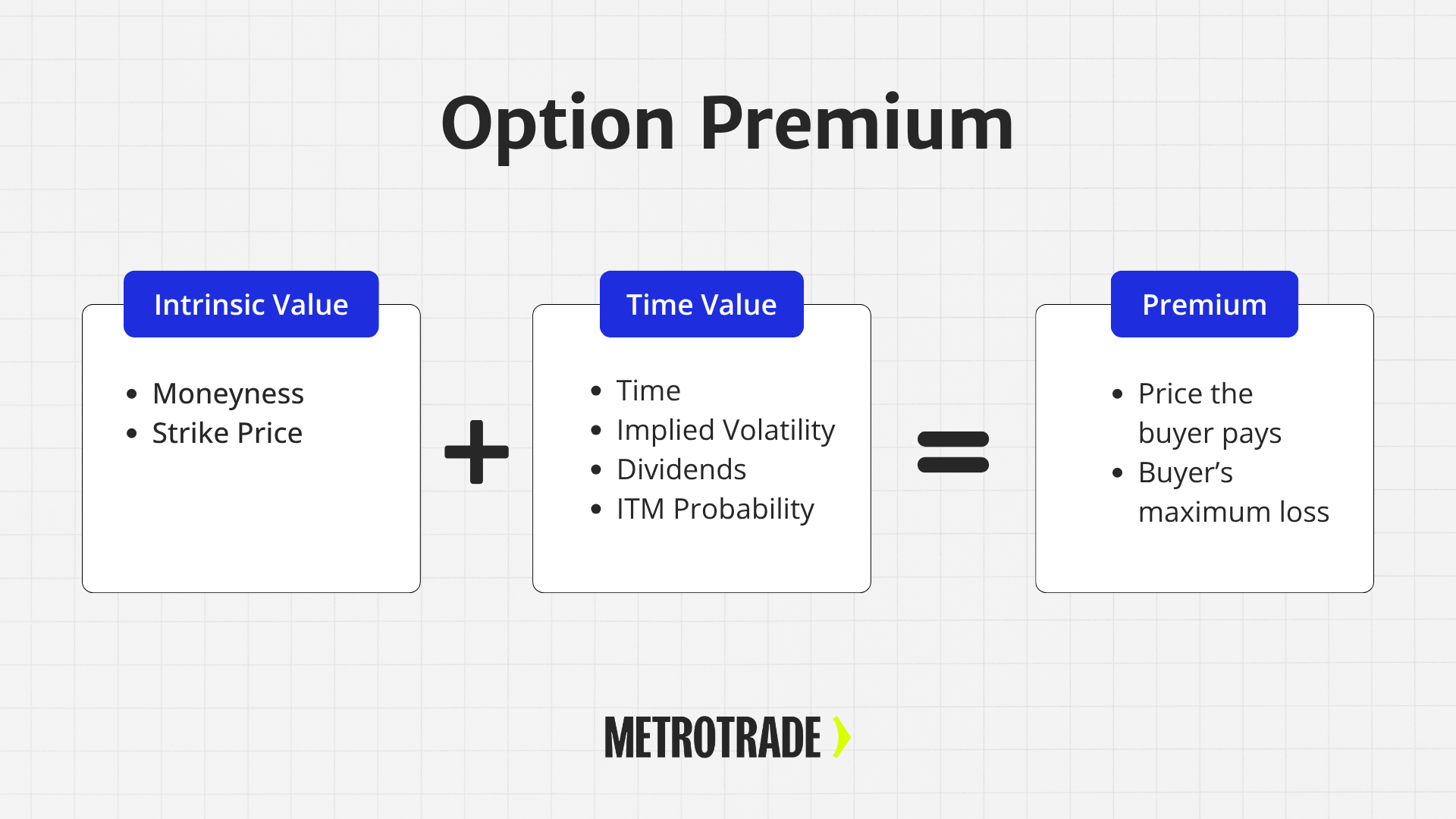
Premium is not a single undifferentiated number. It is the sum of two components that behave very differently over the life of the trade.
Intrinsic value is the floor value of an option. It reflects how far into the money the option already is. For a call, it is the amount by which the current futures price exceeds the strike price. For a put, it is the amount by which the strike price exceeds the current futures price. If an option is at-the-money or out-of-the-money, its intrinsic value is zero.
Time value is everything else. It is the portion of the premium that reflects the time remaining until expiration, the market’s expectation of future volatility, and the probability that the option will move further into the money. Time value exists for every option, regardless of whether it has intrinsic value. It decays to zero by expiration.
Here is a worked example using Gold futures (GC):
- GC futures are trading at 3,500
- A call option with a strike of 3,480 is priced at $22 per ounce
- Intrinsic value: 3,500 minus 3,480 = $20 per ounce (the option is already $20 in the money)
- Time value: $22 minus $20 = $2 per ounce
- Total cost: $22 per ounce times 100 troy ounces = $2,200 for one contract
Now consider an OTM call on the same contract:
- Strike of 3,540 with GC at 3,500
- Premium: $9 per ounce
- Intrinsic value: zero (the option is out-of-the-money)
- Time value: $9 per ounce, the entire premium
- Total cost: $900 for one contract
The ITM option costs more, but part of that cost is real, immediate value. The OTM option costs less, but every dollar of that premium is time value that will erode whether or not GC moves. Understanding which component you are buying matters for how you assess the trade.
What Implied Volatility Does to Premium
Beyond intrinsic value and time, a third force shapes premium: implied volatility (IV). Implied volatility is the market’s expectation of how much the underlying futures price will move over a given period. It is embedded in the time value component of the premium.
When IV is high, options are more expensive. When IV is low, options are cheaper. This happens regardless of what the underlying futures price is doing.
The practical implication is that the timing of your entry affects how much you pay in premiums, even when the strike and expiration are held constant. A trader who buys a call option on E-mini Nasdaq-100 futures (NQ) before a major Federal Reserve announcement is buying into elevated IV. The market is pricing in the possibility of a large move. After the announcement, if the move is modest or volatility simply fades, IV can drop sharply. This compresses the premium even if NQ moves in the right direction.
This is sometimes called a volatility crush, and it catches traders off guard more often than almost any other options dynamic. The position was directionally correct. The market moved the right way. But IV fell faster than intrinsic value accumulated, and the trade returned a loss.
Key points for buyers:
- Avoid buying options just before high-profile events if IV is already elevated, unless the expected move is large enough to overcome a post-event volatility drop
- Lower-IV environments generally offer more favorable entry conditions for options buyers
- Check IV relative to recent historical ranges before buying, not just the absolute premium level
Calculating Break-Even from Premium
Break-even is the futures price at which your trade returns zero profit or loss at expiration. It is the single most useful number to calculate before entering any options trade.
The formula is straightforward:
- Call break-even: Strike price + premium paid (in price units of the underlying)
- Put break-even: Strike price minus premium paid (in price units of the underlying)
Example using ES:
- ES call option, strike 5,400, premium 18.00 points
- Break-even: 5,400 + 18 = 5,418
- One ES point = $50, so the total premium cost is $900
- ES must be above 5,418 at expiration for the trade to generate a net profit
Example using GC:
- GC put option, strike 3,480, premium $14 per ounce
- Break-even: 3,480 minus $14 = 3,466
- One GC contract covers 100 ounces, so the total premium cost is $1,400
- GC must be below 3,466 at expiration for the trade to profit
A few practical notes on break-even:
- The calculation above is based on holding to expiration. If you plan to exit the trade early, the analysis is more dynamic, since time value will still be present in the premium at exit.
- Break-even does not include commissions and fees. Add those to get a true real-world break-even figure.
- Knowing your break-even before entry tells you immediately whether your market view is realistic. If you need a 4% move in 10 days to break even, that constraint should be part of your trade evaluation.
How the Three Variables Work Together
Strike price, expiration, and premium are not independent choices. Every combination of strike and expiration produces a specific premium, and every change to either variable ripples through the trade’s cost, break-even, and risk profile.
A useful way to see this is to map the same bullish view across different strike and expiration combinations.
Setup: ES is trading at 5,350. A trader expects a moderate move higher, somewhere between 1% and 2%, over the next three to four weeks.
|
Structure |
Strike |
Expiration |
Approx. Premium |
Break-Even |
Required Move |
|
OTM, short-dated |
5,450 |
3 weeks |
8 points ($400) |
5,458 |
+2.0% |
|
ATM, short-dated |
5,350 |
3 weeks |
22 points ($1,100) |
5,372 |
+0.4% |
|
ATM, longer-dated |
5,350 |
6 weeks |
32 points ($1,600) |
5,382 |
+0.6% |
All three structures reflect the same directional view. But the cost, break-even, and required move differ substantially:
- The OTM short-dated option is the cheapest but requires the largest and fastest move to profit. Any delay or modest shortfall leaves the trader with a worthless option.
- The ATM short-dated option has a much lower bar to profitability but costs nearly three times as much and is highly sensitive to time decay over the 3-week window.
- The ATM longer-dated option costs more still, but gives the trade two additional weeks to develop. The extra time value has a cost, but it buys tolerance for a slower move.
None of these is universally correct. The right structure depends on how confident the trader is in the magnitude and timing of the expected move. A high-conviction, event-driven trade might justify the OTM short-dated structure. A macro view that might take a month or two to play out favors the longer expiration.
The practical takeaway: build the trade from the view, not from the premium. Start with what you expect the market to do and by when, then find the strike and expiration that match, and evaluate the resulting premium as a cost that must be justified by the trade thesis.
Practical Mistakes to Avoid
Even traders with a sound directional view can lose consistently on options if the mechanics are not well understood. These are the most common errors.
- Choosing OTM strikes based on the dollar cost without calculating break-even. An $8 premium per ounce on a GC option sounds cheap until you realize the required move to profit is $60 per ounce. The premium is only part of the cost equation.
- Buying short-dated options because they are cheap, then watching time decay erase value before the move happens. Time decay is not a background concern. It is an active drag on your position from the moment you enter.
- Buying options before known high-volatility events when IV is already elevated. A volatility crush after a Fed announcement or economic report can produce losses even when the directional call is correct.
- Failing to convert premium from points or per-unit price to dollars before assessing the trade. A premium of 25 points on an ES option is $1,250. Knowing the dollar figure, not just the points, is essential for proper position sizing.
- Treating strike and expiration as separate decisions. They are linked. A very short expiration combined with an OTM strike requires an aggressive, fast move. Most market views do not support that structure.
- Not having a plan for early exit. Most retail traders do not hold options to expiration. If you buy an option and the underlying moves sharply in your favor, the question of when to exit should be answered before you enter.
Conclusion
Strike price, expiration, and premium are the three inputs that determine what an options on futures trade actually costs and what it requires from the market to be profitable. Each one is straightforward on its own. The complexity and the skill are in understanding how they interact.
The strike sets the target. Expiration sets the clock. And premium reflects the cost of both choices, split between value that already exists and value that is decaying from the moment you enter. A trader who can calculate break-even, account for time decay, and assess whether the required move is realistic given the time available is working from a sound foundation.
MetroTrade offers long calls and long puts on CME-listed futures contracts, including ES, NQ, CL, and GC. If you’re ready to start trading options on futures, open an account today and request access.
Frequently Asked Questions
What is the strike price in options on futures?
The strike price is the price at which the buyer of an option has the right to enter the underlying futures contract. For a call, it is the price at which the buyer can go long the futures. For a put, it is the price at which the buyer can go short. The strike price does not change after the option is purchased and directly determines the trade’s break-even point.
How does expiration work for options on futures?
Options on futures have a set expiration date, after which the contract ceases to exist. At expiration, in-the-money options can be exercised into a futures position; out-of-the-money options expire worthless. Most retail traders close positions before expiration rather than exercising. CME-listed options come in quarterly, serial, and, in some cases, weekly expiration cycles.
What is a premium in options on futures?
Premium is the price paid by the buyer to purchase an options contract. It represents the buyer’s maximum loss on the trade. Premium is made up of two components: intrinsic value, which reflects how far in the money the option already is, and time value, which reflects time remaining before expiration and the market’s expectation of future movement.
What is the difference between intrinsic value and time value?
Intrinsic value is the amount by which an option is in the money. A call option on GC with a strike of 3,480 when GC futures are at 3,500 has $20 per ounce of intrinsic value. Time value is the remaining portion of the premium, reflecting time to expiration and implied volatility. An out-of-the-money option has no intrinsic value; its entire premium is time value that will decay to zero by expiration.
What is time decay, and how does it affect options on futures buyers?
Time decay, measured by theta, is the rate at which an option loses time value as expiration approaches. It works against buyers and in favor of sellers. The decay is not linear; it accelerates in the final weeks before expiration. A buyer who holds an option without the underlying moving in their favor will see the premium erode each day, regardless of what the market does.
How do I calculate break-even on an options on futures trade?
For a call, break-even equals the strike price plus the premium paid, expressed in the same price units as the underlying. For a put, break-even equals the strike price minus the premium paid. For example, an ES call with a strike of 5,400 and a premium of 18 points has a break-even of 5,418. ES must be above that level at expiration for the trade to generate a net profit.
How do I choose a strike price and expiration for options on futures?
Start with your market view: what direction do you expect, how large a move, and over what timeframe? Use those answers to select a strike that puts your break-even at a realistic level and an expiration that gives the trade enough time to develop. Then evaluate the resulting premium as a cost that needs to be justified by the trade thesis, not as the starting variable in the decision.
The content provided is for informational and educational purposes only and should not be considered trading, investment, tax, or legal advice. Futures trading involves substantial risk and is not suitable for every investor. Past performance is not indicative of future results. You should carefully consider whether trading is appropriate for your financial situation. Always consult with a licensed financial professional before making any trading decisions. MetroTrade is not liable for any losses or damages arising from the use of this content.
Transactions in options carry a high degree of risk. Purchasers and sellers of options should familiarize themselves with the type of option (i.e. put or call) which they contemplate trading and the associated risks. You should calculate the extent to which the value of the options must increase for your position to become profitable, taking into account the premium and all transaction costs. The purchaser of options may offset or exercise the options or allow the options to expire. The exercise of an option results either in a cash settlement or in the purchaser acquiring or delivering the underlying interest. If the option is on a future, the purchaser will acquire a futures position with associated liabilities for margin (see the section on Futures above). If the purchased options expire worthless, you will suffer a total loss of your investment, which will consist of the option premium plus transaction costs. If you are contemplating purchasing deep out-of-the-money options, you should be aware that the chance of such options becoming profitable ordinarily is remote. Selling (‘writing’ or ‘granting’) an option generally entails considerably greater risk than purchasing options.
Although the premium received by the seller is fixed, the seller may sustain a loss well in excess of that amount. The seller will be liable for an additional margin to maintain the position if the market moves unfavorably. The seller will also be exposed to the risk of the purchaser exercising the option, and the seller will be obligated to either settle the option in cash or to acquire or deliver the underlying interest. If the option is on a future, the seller will acquire a position in a future with associated liabilities for margin (see the section on Futures above). If the position is ‘covered’ by the seller holding a corresponding position in the underlying interest or a future or another option, the risk may be reduced. If the option is not covered, the risk of loss can be unlimited. Certain exchanges in some jurisdictions permit deferred payment of the option premium, exposing the purchaser to liability for margin payments not exceeding the amount of the premium. The purchaser is still subject to the risk of losing the premium and transaction costs. When the option is exercised or expires, the purchaser is responsible for any unpaid premiums outstanding at that time.