


The 3-5-7 rule is a risk management framework that gives traders a structured way to control losses, limit overexposure, and target profits that outweigh their losing trades. Each number sets a clear boundary: how much to risk on a single trade, how much to have exposed across all open positions, and how much to aim for when a trade goes in your favor.
This guide breaks down how each part of the rule works, how to apply it to real futures trades, and how it compares to other common risk frameworks.
Key Takeaways
- The 3-5-7 rule sets three clear risk boundaries. It limits single-trade risk to 3% of your account, caps total open exposure at 5%, and targets a minimum profit of 7% on winning trades.
- The 3% per-trade limit protects capital through losing streaks. Capping each trade’s risk at a small percentage of your account means no single loss can do serious damage, even in a string of bad trades.
- Total exposure matters as much as per-trade risk. Two or three positions each within the 3% limit can still represent concentrated risk if those markets move together, which makes the 5% cap essential.
- The 7% profit target is about ratio, not a guarantee. Setting your winning trades to earn more than your losses means you don’t need to win every trade for the math to work in your favor over time.
- The rule adapts to account size and market conditions. Traders with smaller accounts or during high-volatility periods often tighten per-trade risk to 1-2%, keeping the structure intact while reducing exposure.
What Is the 3-5-7 Rule in Trading?
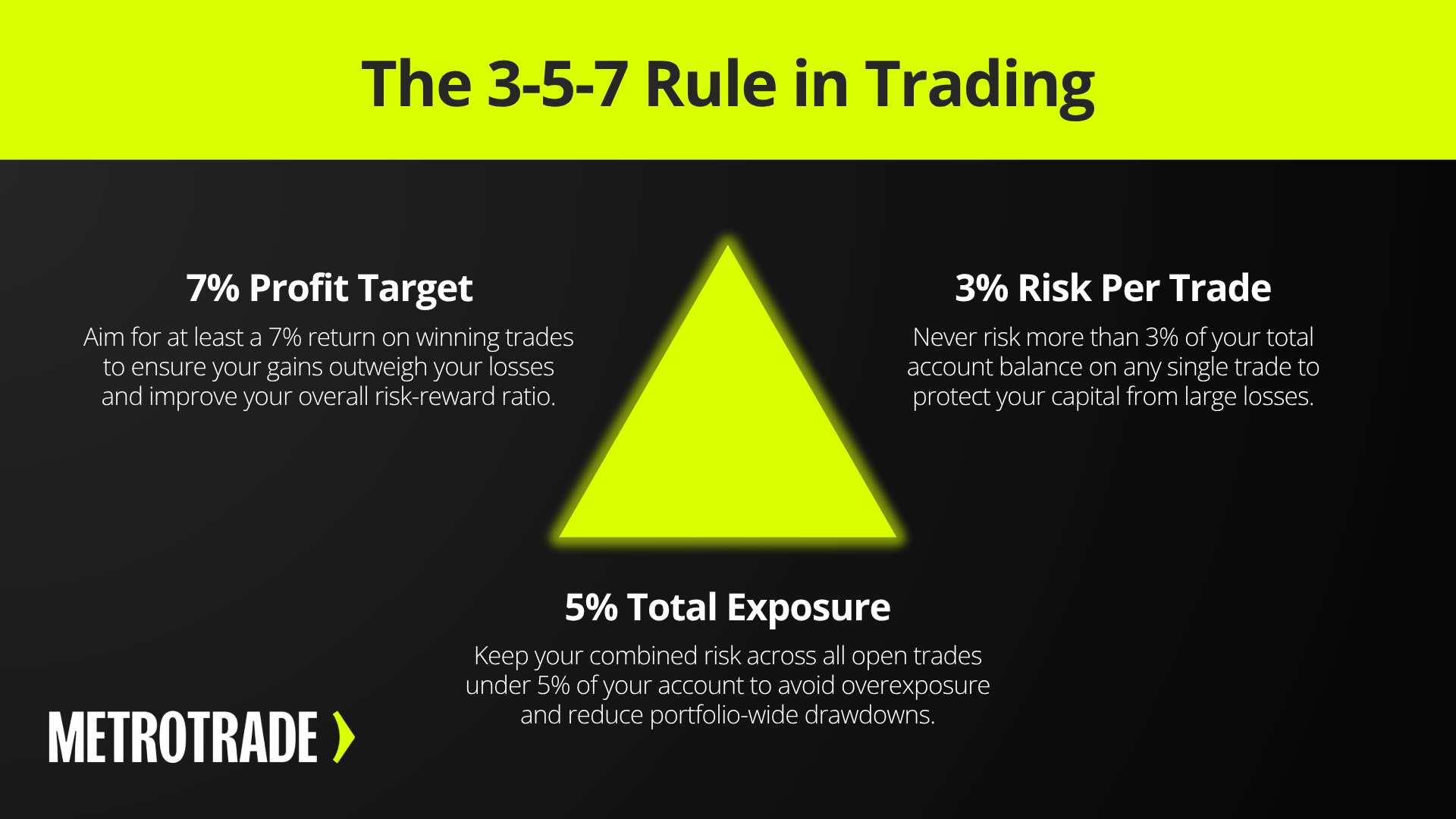
The 3-5-7 rule is a straightforward risk management framework that helps traders limit losses, manage exposure, and focus on high-quality trade setups. It’s designed to bring structure and discipline to the decision-making process, especially in volatile markets like futures.
At its core, the 3-5-7 rule sets three clear boundaries:
- 3%: The maximum amount of your trading capital to risk on any single trade.
- 5%: The total capital you should have exposed across all open positions at any given time.
- 7%: The minimum profit target to aim for on winning trades.
Each number serves a different purpose. The 3% cap limits damage from any one bad trade. The 5% cap prevents your portfolio from becoming too concentrated or overleveraged across multiple positions. The 7% target keeps your winners doing more work than your losers.
The rule doesn’t require complex software or advanced math. It works on percentages, so it scales with your account size whether you’re trading with $5,000 or $100,000. Many traders use it as a foundation for more advanced strategies. It’s especially useful for newer traders still developing consistency and learning to protect capital.
Trade Futures with a Small Account
Start your live trading application and begin with margins as low as $50 per contract.
Breaking Down Each Part of the Rule
The 3% Rule: Limit Risk Per Trade
The first part of the rule defines how much you can afford to lose on any single trade. The 3% limit means that if a trade goes against you and hits your stop-loss, you lose no more than 3% of your account balance.
Why 3% and not more?
- It keeps any single loss manageable, even during a run of bad trades.
- It forces you to think carefully about stop-loss placement and position size before entering.
- It removes the temptation to size up on a setup that “feels certain.”
How to calculate it:
Multiply your account balance by 0.03. That’s your maximum dollar risk per trade.
- $10,000 account: maximum risk per trade = $300
- $25,000 account: maximum risk per trade = $750
From there, use your stop-loss distance to determine how many contracts to trade. The formula is:
Contracts = Maximum risk ($) / (Stop distance in ticks x Tick value)
Traders with smaller accounts or those active during high-volatility sessions often reduce this to 1-2% per trade. That’s a reasonable adjustment, and it doesn’t break the rule’s structure. The key is staying consistent within whatever percentage you set.
The 5% Rule: Cap Total Portfolio Exposure
Even if every individual trade follows the 3% limit, holding multiple open positions can stack exposure in ways that are easy to underestimate. The 5% rule addresses this by capping your total active risk across all open trades.
What 5% looks like in practice:
With a $10,000 account, total exposure across all open trades should not exceed $500. That could mean two trades risking $250 each, or one at $300 and one at $200.
Correlation is the hidden risk here.
Two positions each within the 3% limit can still represent concentrated exposure if those markets are highly correlated. A trader long on the Micro E-mini S&P 500 (MES) and long on the Micro Nasdaq (MNQ) at the same time is effectively holding two positions that tend to move together. If the equity market drops, both positions are likely to hit their stops.
This is one of the most common ways the 5% rule gets violated in practice, not by putting too much on one trade, but by stacking correlated trades that behave like a single position.
The 5% cap also adjusts dynamically. As your account grows through profitable trading, your absolute dollar risk allowance increases too. Conversely, after a drawdown period, the cap shrinks, naturally forcing more conservative sizing.
The 7% Rule: Set Meaningful Profit Targets
The third part of the rule shifts focus from protection to reward. While the first two rules keep losses contained, the 7% rule ensures that when trades go right, the gains are large enough to matter.
What 7% means in practice:
If you’re risking 3% on a trade, you should target at least 7% on the winning side. This creates a risk-to-reward ratio of roughly 2.3:1, meaning your winners need to be more than twice the size of your losers.
With that ratio, you can lose more trades than you win and still come out ahead:
- Win 4 out of 10 trades, losing $300 on each loser and gaining $700 on each winner: net result is +$400 over those 10 trades.
The 7% rule also addresses a common behavioral trap: cutting winners too early. Most traders are wired to take profits quickly after a trade moves in their favor, which results in small winners that can’t cover the inevitable losers. Setting a defined target in advance reduces the temptation to exit early.
How to Apply the 3-5-7 Rule: Step by Step
Here’s a repeatable process for applying the rule before each trade:
- Calculate your 3% risk cap. Multiply your current account balance by 0.03. This is the maximum dollar amount you can lose if the trade hits your stop.
- Determine your stop-loss distance. Based on your chart analysis, identify where your stop-loss will be placed. Express this in ticks for the contract you’re trading.
- Calculate your position size. Divide your maximum risk by the dollar value of your stop distance (ticks x tick value). Round down to the nearest whole contract.
- Check your total open exposure. Add this trade’s risk to the risk already sitting in any open positions. If the total exceeds 5% of your account, either pass on the trade or reduce size.
- Set your profit target before entering. Your take-profit level should reflect at least 7% of your account, or a minimum 2:1 risk-to-reward ratio, whichever gives you a clearer chart-based target.
- Log the trade. Record your entry, stop, target, and dollar risk before placing the order. Review results after the trade closes.
This process takes less than two minutes once it becomes routine, but it eliminates most of the sizing errors that cause unnecessary losses.
Worked Example: Applying the 3-5-7 Rule to Futures
Here’s how the rule works using a real futures contract.
- Account size: $10,000
- Contract: Micro E-mini S&P 500 (MES)
- MES contract specs: 1 tick = $1.25, 4 ticks per point, 1 point = $5.00
Step 1: Calculate Risk and Position Size
Your analysis identifies a trade setup with a stop-loss 10 points below your intended entry.
- 3% of $10,000 = $300 maximum risk
- 10 points x $5.00 per point = $50 risk per contract
- Position size: $300 / $50 = 6 MES contracts
Step 2: Check Portfolio Exposure
You have one other trade open on the Micro Nasdaq (MNQ) with $150 at risk.
- Total exposure: $300 (MES) + $150 (MNQ) = $450
- $450 / $10,000 = 4.5% — within the 5% cap
Note: both positions are in equity index futures, so they carry correlation risk. Both trades moving against you in the same session is a realistic scenario. You’re within the 5% rule, but it’s worth acknowledging that this isn’t the same as holding two uncorrelated positions.
Step 3: Set Profit Target
Targeting at least 7% of your $10,000 account means a profit target of $700 on this trade.
- $700 / $5.00 per point = 140 points needed to hit target
- Or alternatively, a 2:1 R:R at minimum: $300 risk x 2 = $600 target (20 points x 6 contracts)
In practice, a chart-based target at 20+ points away is reasonable on MES. If your nearest logical resistance level is only 8 points away, that doesn’t support a 2:1 ratio, and the trade may not be worth taking under this rule.
Result
If the trade hits your stop: loss of $300 (3% of account). If it hits a 20-point target: gain of $600 (2:1). The math holds. Repeat this process consistently, and the ratio does the work over time.
Common Mistakes When Using the 3-5-7 Rule
Even a simple rule gets broken in practice. Here are the most common errors:
- Breaking the 3% limit on “high-conviction” trades. The rule doesn’t have a conviction exception. Markets can and do move against even the cleanest setups, and sizing up on certainty is how accounts take large, unexpected losses.
- Ignoring correlation between open positions. Two positions each within the 3% limit can still expose you to concentrated risk if they’re in correlated markets. Equity index futures in particular, such as MES, MNQ, and ES, tend to move together. Factor this in when checking your 5% cap.
- Forgetting commission costs in profit calculations. Your take-profit level should reflect the net gain after round-turn commissions, not just the gross move. This matters more for active traders placing multiple trades per session.
- Not adjusting for volatility. A 10-point stop on MES works well in a normal session. During a high-impact economic release, the same stop might get triggered by routine noise before the trade has a chance to develop. In volatile conditions, consider tightening your per-trade risk to 1-2% and reducing position size accordingly.
- Closing winning trades early despite the target. Setting a 7% target and then closing at 3% when the trade moves your way defeats the purpose of the rule. The profit target exists precisely because our instinct is to exit too early. Trust the plan.
- Treating the percentages as fixed for all situations. The 3-5-7 framework is a starting point, not a one-size-fits-all mandate. New traders, small accounts, and high-volatility markets may all call for tighter numbers.
How the 3-5-7 Rule Compares to Other Risk Frameworks
The 3-5-7 rule isn’t the only risk management framework in use. Understanding where it sits relative to alternatives helps you decide whether it fits your trading style.
The 1% Rule
The 1% rule limits per-trade risk to just 1% of your account. It’s the most conservative common approach and is often recommended for traders with very small accounts, high-frequency scalpers where commissions eat into returns quickly, or anyone in a drawdown period who needs to reduce exposure while rebuilding consistency.
The tradeoff: with 1% risk per trade, you need a large winner or a high win rate to move the account meaningfully. For active futures traders, this can feel restrictive.
The 2% Rule
The 2% rule is a widely used middle ground. It offers more protection than the 3-5-7 framework on a per-trade basis while still allowing meaningful position sizes on standard futures contracts.
Many experienced traders use 2% as a ceiling on normal trades and reserve up to 3% for setups with strong confluences or wider technical stops.
Where the 3-5-7 Rule fits
The 3-5-7 rule is best suited for beginner to intermediate traders who want a complete framework covering per-trade risk, portfolio exposure, and profit targeting in one set of rules. It’s practical for futures accounts in the $5,000 to $50,000 range, and the 7% profit component adds something the 1% and 2% rules don’t address at all: structure around when to take profits.
No framework eliminates risk. The value of any rule is in applying it consistently, not in finding the perfect percentage.
Limitations and When to Adjust the Rule
The 3-5-7 rule is a practical starting point, but it has limitations worth understanding.
- It may be too aggressive for very small accounts. On a $3,000 account, a 3% risk cap equals $90 per trade. After factoring in commissions and stop distance, that may not be enough to take a standard futures position in size.
- It assumes liquid, orderly markets. In fast markets or around major economic releases, slippage can cause actual losses to exceed your planned risk. This doesn’t break the rule, but it means your stop-loss placement needs to account for wider bid-ask spreads and execution delays.
- It doesn’t account for correlation by design. The 5% cap treats each position as independent. In practice, correlated positions reduce the protection the cap provides. Traders holding multiple equity index futures positions should mentally adjust their effective exposure upward.
- The 7% target isn’t always achievable on the chart. Not every setup offers a logical exit point that supports a 2:1+ risk-to-reward ratio. Forcing a trade to fit the rule when the chart doesn’t support the target can lead to poor entries or unrealistic expectations.
When to tighten the rule: during high-volatility sessions, after a string of losses, or when holding correlated positions, consider dropping per-trade risk to 1-2% and letting that guide your sizing until conditions normalize.
Conclusion
The 3-5-7 rule gives traders a repeatable structure for managing risk at three levels: single-trade loss, total portfolio exposure, and minimum profit targets. It won’t prevent losing trades, and it doesn’t need to. Its value is in keeping losses small and predictable while giving winning trades enough room to matter.
For futures traders in particular, the rule pairs well with real contract math. Knowing your MES tick value, your stop distance in points, and your account’s 3% cap gives you a precise position size before you ever place an order. That kind of pre-trade structure removes most of the sizing errors that compound into larger problems.
If you’re ready to put the rule to work in live markets, you can open a MetroTrade account and access futures contracts with competitive intraday margins and per-side commissions starting at $0.29 for micro contracts.
Frequently Asked Questions
What is the 3-5-7 rule in trading?
The 3-5-7 rule is a risk management framework that limits single-trade risk to 3% of your account, caps total open exposure across all positions at 5%, and sets a minimum profit target of 7% on winning trades. It’s designed to help traders control losses at multiple levels while keeping winning trades large enough to offset losers.
How do you calculate 3% risk per trade?
Multiply your current account balance by 0.03. For a $10,000 account, the maximum risk per trade is $300. Use that dollar amount alongside your planned stop-loss distance and the contract’s tick value to determine how many contracts to trade.
Why does the 5% rule matter if each trade is already under 3%?
Two trades each at 3% risk equals 6% total exposure, which breaks the 5% cap. The 5% rule prevents you from holding too many positions simultaneously, which matters especially when those positions are in correlated markets that can move against you at the same time.
What does a 7% profit target mean in practice?
It means aiming for a gain of at least 7% of your account balance on winning trades, or roughly a 2:1 risk-to-reward ratio. If you risk $300 on a trade, your target should return at least $600-$700. The goal is to make winning trades large enough to offset multiple small losses.
How does the 3-5-7 rule compare to the 1% or 2% rule?
The 1% rule is the most conservative, limiting each trade’s risk to just 1% of your account. The 2% rule is a common middle ground. The 3-5-7 rule is less conservative on a per-trade basis but adds two elements the others don’t: an explicit portfolio exposure cap (5%) and a profit target structure (7%). It’s most practical for beginner to intermediate traders with accounts large enough to size positions appropriately.
Is the 3-5-7 rule good for beginner futures traders?
It’s a reasonable starting framework. The rules are simple to calculate, apply to any account size, and address the three areas where new traders most often run into problems: oversizing individual trades, holding too many positions at once, and closing winners too early. Beginner traders should pair the rule with demo or paper trading before applying it in live markets.
Can you adjust the percentages in the 3-5-7 rule?
Yes. The percentages are guidelines, not requirements. Many traders tighten per-trade risk to 1-2% during high-volatility periods, after a losing streak, or when holding correlated positions. The structure of the rule, controlling per-trade risk, total exposure, and profit targets, remains valid at any percentage.
What is the biggest limitation of the 3-5-7 rule?
The rule doesn’t account for correlation between positions. Two trades each within the 3% limit can still create concentrated exposure if both positions react to the same market driver. Equity index futures like MES and MNQ tend to move together, so holding both simultaneously requires an honest assessment of effective total exposure, not just a mechanical check of the 5% cap.
The content provided is for informational and educational purposes only and should not be considered trading, investment, tax, or legal advice. Futures trading involves substantial risk and is not suitable for every investor. Past performance is not indicative of future results. You should carefully consider whether trading is appropriate for your financial situation. Always consult with a licensed financial professional before making any trading decisions. MetroTrade is not liable for any losses or damages arising from the use of this content.